KVS PGT Subject Knowledge: How to Prepare and Revise Effectively
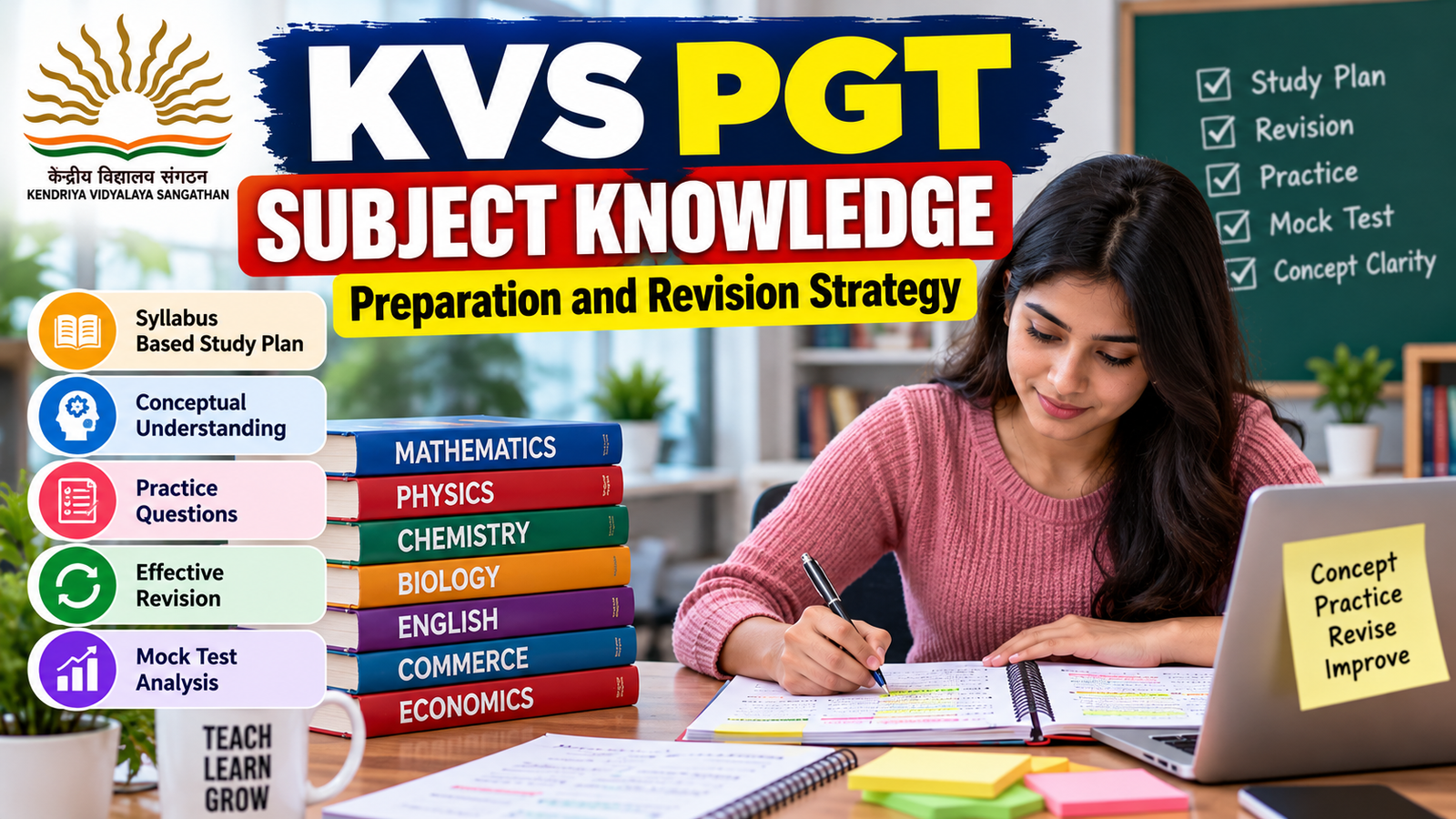
Preparing for a Post Graduate Teacher (PGT) position requires a strong understanding of the prescribed subject syllabus, conceptual clarity and consistent revision. Candidates must develop the ability to recall important concepts, solve relevant questions and apply their knowledge accurately.
An effective KVS PGT subject knowledge preparation strategy combines syllabus-based study, topic-wise practice, active recall and regular performance analysis. However, the right approach depends on your subject, current preparation level and the requirements of the latest recruitment notification.
Whether you are preparing for Mathematics, English, Physics, Chemistry, Biology, Commerce, Economics or another PGT subject, a structured study plan can help you organise your preparation and identify areas that need improvement.
In this guide, you will learn how to prepare subject-wise, create a realistic revision timetable, practise questions effectively and improve your conceptual understanding.
1. Start Your KVS PGT Preparation With the Latest Official Syllabus
Before selecting books or preparing a timetable, review the latest applicable Kendriya Vidyalaya Sangathan (KVS) recruitment notification and subject syllabus.
Official website: https://kvsangathan.nic.in/
The official syllabus helps you understand which topics need to be covered and prevents you from spending unnecessary time on material that may not be relevant to the applicable examination.
Create a Topic-Wise Syllabus Checklist
Divide the syllabus into three categories:
- Strong topics: Concepts you understand well and can explain or solve confidently.
- Moderate topics: Concepts you understand but need to practise regularly.
- Weak topics: Areas that require fresh study, additional practice or teacher guidance.
Mark each topic as you complete it. Revisit your checklist regularly to ensure that you are balancing new learning with revision.
Do not automatically rely on an older recruitment cycle’s syllabus, examination pattern or selection procedure. Always verify the latest applicable official notification.
2. Build Strong Conceptual Understanding
A strong foundation is essential for effective KVS PGT subject preparation. Simply memorising definitions, formulas or answers may not be sufficient when a question requires you to apply a concept in a different context.
For every topic, ask yourself three questions:
- What is the concept?
- Why does it work?
- How can I apply it to a question or practical example?
Use a Subject-Specific Learning Approach
Different subjects require different preparation methods.
Mathematics: Understand formulas, derivations, mathematical principles and their applications. Practise problems of varying difficulty levels according to the prescribed syllabus.
Physics: Focus on fundamental laws, conceptual relationships, numerical problems, units and the application of principles.
Chemistry: Organise your preparation around the prescribed concepts, reactions, equations, numerical applications and relevant theoretical topics.
Biology: Understand biological processes, terminology, diagrams, classifications and relationships between concepts wherever applicable.
English: Revise the prescribed language and literature topics, grammar, comprehension and critical interpretation according to the syllabus.
Commerce and Economics: Focus on definitions, theories, principles, numerical applications and conceptual relationships relevant to your subject.
Use standard textbooks and reliable study materials that align with the official syllabus. Prioritise conceptual clarity over collecting too many resources.
3. Follow a Topic-Wise KVS PGT Study Strategy
A repeatable study method helps you complete topics systematically and identify learning gaps before they affect your performance.
Step 1: Study the Concept
Read the relevant chapter or topic carefully. Focus on understanding the main principles rather than memorising every line.
Step 2: Prepare Concise Notes
Write down important definitions, formulas, rules, examples and difficult concepts. Keep your notes short enough to revise efficiently.
Step 3: Solve Practice Questions
Begin with basic questions to check your understanding. Gradually move to moderate and advanced questions appropriate to your syllabus and preparation level.
Step 4: Analyse Your Mistakes
Review every incorrect answer and identify the reason behind it. Determine whether the mistake occurred because of a conceptual gap, forgotten formula, calculation error or misunderstanding of the question.
Step 5: Revise at Planned Intervals
Revisit the topic after a short interval, then test your understanding again. This helps you identify whether you can recall and apply the concept without relying on your notes.
Following these steps makes your preparation more structured and helps you move from basic understanding to independent problem-solving.
4. Create a Realistic KVS PGT Revision Timetable
A well-planned KVS PGT revision strategy should balance conceptual learning, practice questions and the revision of previously studied material.
Here is a sample daily timetable for candidates who can dedicate approximately four focused hours to preparation.
| Study Activity | Suggested Time | Purpose |
|---|---|---|
| Concept study and revision | 90 minutes | Understand or revise a syllabus topic |
| Topic-wise practice | 60 minutes | Solve relevant subject questions |
| Mistake and previous-practice review | 45 minutes | Revisit incorrect and difficult questions |
| Active recall | 30 minutes | Recall formulas, facts and key concepts |
| Planning the next session | 15 minutes | Set priorities for the following day |
Total focused study time: 4 hours
This timetable is a sample, not a compulsory schedule. Adjust the study hours according to your responsibilities, subject difficulty, current preparation level and examination timeline.
How to Adjust Your Revision Plan
- If you are beginning preparation, allocate more time to learning fundamental concepts.
- If you have completed most of the syllabus, increase revision and practice.
- If you repeatedly forget concepts, schedule additional active-recall sessions.
- If you struggle with questions, spend more time analysing errors before attempting another practice set.
- If the examination is approaching, prioritise important syllabus areas, previous mistakes and timed practice.
The objective is to create a sustainable routine that you can follow consistently.
5. Use Active Recall Instead of Repeated Reading
Reading the same chapter multiple times may make the material feel familiar, but familiarity does not always mean that you can recall the information independently.
Active recall involves retrieving information from memory without looking at your notes first.
Practical Active Recall Techniques
- Write from memory: Close your book and write important formulas, definitions or concepts.
- Explain concepts aloud: Describe a topic in simple language as if you were teaching it to someone.
- Solve questions independently: Attempt practice questions before checking the solutions.
- Create short flashcards: Use question-and-answer cards for terminology, definitions and important facts.
- Maintain a mistake notebook: Record recurring errors and revisit them during revision.
- Use spaced revision: Revisit difficult concepts at planned intervals instead of leaving them until the final days.
After recalling a topic, compare your answer with your notes or textbook. Correct missing details and test yourself again later.
This method helps you identify what you genuinely remember and which concepts still require additional work.
6. Practise KVS PGT Subject Knowledge Questions
Practice questions help you evaluate whether you can apply what you have studied. Select questions that match your subject and the latest applicable syllabus.
Choose Practice Questions According to Your Subject
For Mathematics, focus on conceptual problems, formulas and calculations.
For Physics and Chemistry, practise relevant theoretical questions, numerical problems and the application of scientific principles.
For Biology, revise concepts, processes, terminology and relationships between topics.
For English, practise the prescribed language, grammar, literature and comprehension components.
For Commerce and Economics, work on theories, definitions, principles and numerical applications wherever relevant.
Analyse Every Practice Set
After completing a set of questions, classify your mistakes into the following categories:
- Conceptual error: The underlying topic was not understood properly.
- Forgotten formula or fact: You could not recall the required information.
- Misreading: You overlooked an important word, condition or instruction.
- Calculation mistake: You understood the method but made an error while solving.
- Time-management issue: You spent too much time on a question.
Use these categories to decide what to revise next. Avoid simply memorising the correct answer without understanding the reasoning behind it.
7. Use Previous-Year Questions and Mock Tests Effectively
Previous-year questions and mock tests can help you practise applying concepts under examination-style conditions. They can also reveal topics that require further revision.
However, previous-year papers should be used alongside the latest official syllabus rather than as a substitute for it.
Follow a Structured Practice Process
- Complete the relevant concepts before attempting a topic-based test.
- Solve questions independently under suitable time limits.
- Check your answers and review the explanations.
- Record recurring mistakes in your notebook.
- Revise weak topics and solve a new set of questions.
- Compare performance across multiple practice sessions.
When attempting a full-length mock test, follow the applicable examination instructions and time limits.
Do not judge your preparation only by your score in one test. Consider the difficulty level, accuracy, conceptual gaps and ability to solve questions within the available time.
8. Prepare for a Subject-Related Interview or Teaching Demonstration
If the applicable KVS recruitment process includes an interview or teaching demonstration, review the official selection procedure before planning your preparation.
Where a demo lesson is required, you may need to demonstrate not only subject knowledge but also the ability to explain concepts clearly and organise a lesson effectively.
Structure Your Demo Lesson
A clear teaching demonstration can include:
- Learning objective: Explain what students should learn.
- Prior knowledge: Connect the topic with concepts students already understand.
- Introduction: Begin with a relevant example, question or simple explanation.
- Concept explanation: Present the material step by step.
- Student participation: Use questions or short activities to encourage engagement.
- Assessment: Check whether students have understood the topic.
- Recap: Summarise the main learning points.
Practise explaining a topic within the assigned time. Select a concept suitable for the target class instead of trying to cover an entire chapter in a short demonstration.
The exact recruitment stages and evaluation requirements should always be verified through the latest official notification.
9. Common KVS PGT Preparation Mistakes to Avoid
Even candidates who study regularly may struggle to make progress if their preparation lacks structure.
Avoid these common mistakes:
Studying Without Checking the Latest Syllabus
Use the applicable official syllabus to guide your preparation. This helps you prioritise relevant topics and avoid unnecessary study.
Collecting Too Many Books and Resources
Repeatedly switching between study materials can waste time. Select reliable resources and use them consistently.
Memorising Without Understanding
Memorisation alone may not help when a question requires conceptual application. Understand the reasoning behind formulas, definitions and principles.
Ignoring Revision While Completing New Topics
Completing new chapters is important, but previously studied topics can be forgotten without revision. Reserve time for active recall and practice.
Taking Practice Tests Without Analysing Mistakes
A test is more useful when you understand what went wrong and take action to correct it.
Spending Too Much Time on Strong Topics
Practising familiar topics can feel productive, but weak areas may require greater attention. Use your performance data to distribute study time effectively.
Assuming an Old Paper Guarantees the Future Exam Pattern
Previous-year questions are useful practice resources, but they do not guarantee the same questions, syllabus or examination structure in a future recruitment cycle.
Consistent preparation, targeted revision and syllabus alignment are more useful than frequently changing your study strategy.
10. KVS PGT Preparation Support at TN Academy®
TN Academy® provides government job coaching in Bahadurgarh, Haryana. Candidates preparing for competitive examinations can contact the institute to enquire about available subject guidance, practice sessions and interview or demo preparation support, depending on the current programme.
Before choosing a preparation programme, identify your weak topics, assess your current level and decide which type of guidance would be most useful for your preparation.
Contact TN Academy®
Phone/WhatsApp: 9729299034
Website: https://tnacademy.in/
Address: 3rd Floor, Radha Ganga Arcade, Opposite Jhajjar Mod, Delhi–Rohtak Road, Metro Pillar 848, Bahadurgarh, Haryana 124507.
Frequently Asked Questions About KVS PGT Subject Knowledge
1. How should I start KVS PGT subject preparation?
Begin by reviewing the latest official recruitment notification and subject syllabus. Divide the topics into strong, moderate and weak areas, then create a realistic study and revision timetable.
2. Is reading a topic once enough for KVS PGT preparation?
Usually, one reading is not sufficient for reliable recall. Combine conceptual study with practice questions, active recall and repeated revision to strengthen your understanding.
3. How can I remember difficult subject concepts?
Explain concepts in your own words, practise relevant questions, prepare concise notes and revisit difficult material at planned intervals. Active recall can help you identify gaps in your understanding.
4. Should I practise previous-year questions for KVS PGT?
Yes, previous-year questions can help you practise relevant concepts and understand question styles. Use them alongside the latest official syllabus because past papers do not guarantee the pattern of a future examination.
5. How many hours should I study daily for KVS PGT?
Your study hours should depend on your preparation level, subject difficulty, daily responsibilities and examination timeline. A consistent, focused routine with time for revision and practice is more useful than following an unrealistic schedule.
6. How can I prepare for a KVS PGT teaching demonstration?
If a teaching demonstration is part of the applicable selection process, practise explaining a syllabus-related concept with a clear objective, step-by-step explanation, student interaction and a short recap. Confirm the actual selection requirements in the latest official notification.
7. Where can I check the official KVS recruitment notification?
Visit the official Kendriya Vidyalaya Sangathan website at https://kvsangathan.nic.in/ to find applicable recruitment notifications, eligibility requirements, syllabus details and selection information.
Important Note
Recruitment dates, eligibility conditions, syllabus, examination patterns and selection stages may change. Always verify the latest applicable KVS recruitment notification and official instructions before making examination-related decisions.

You may also like
SSC CGL Mock Test Strategy: How to Improve Speed and Accuracy
NDA Written Exam: Time Management and Mock Test Analysis