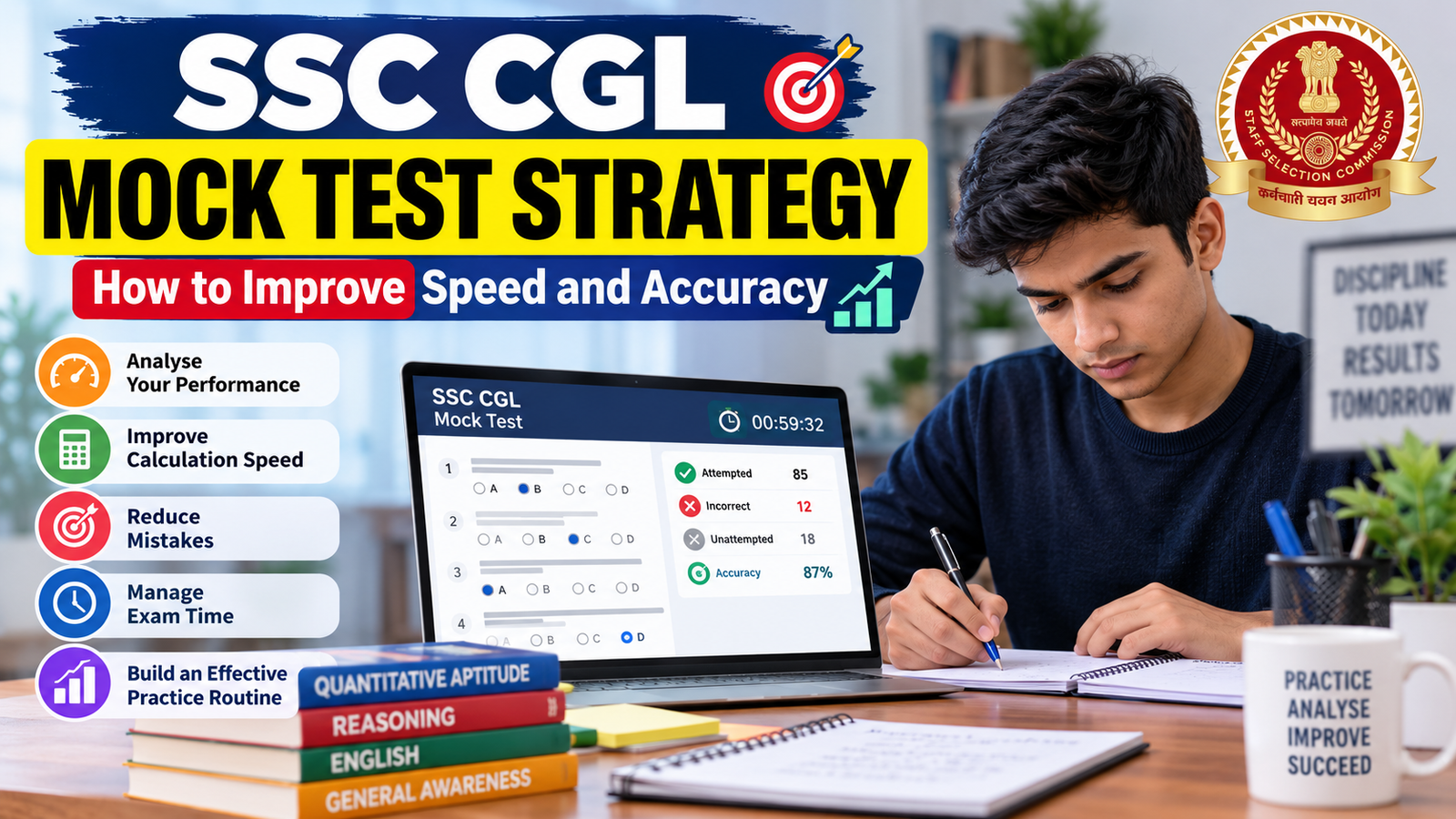
SSC CGL Mock Test Strategy: How to Improve Speed and Accuracy
Preparing for the SSC Combined Graduate Level (CGL) examination requires more than understanding concepts and memorising formulas. Candidates must also develop the ability to solve questions accurately, manage time effectively and make smart decisions under exam pressure.
A well-planned SSC CGL mock test strategy helps candidates identify weak areas, improve question-selection skills and evaluate their overall preparation. However, simply attempting multiple mock tests without analysing the results may not lead to consistent improvement.
The key is to follow a structured approach that combines timed practice, detailed performance analysis, targeted revision and regular progress tracking.
In this guide, you will learn how to attempt SSC CGL mock tests effectively, improve calculation speed, reduce avoidable mistakes and create a practical weekly revision routine.
1. Understand the Purpose of an SSC CGL Mock Test
An SSC CGL mock test is not just a way to check your score. It is a practical tool for evaluating your preparation and identifying the areas that require improvement.
Regular mock tests can help you assess:
- Conceptual understanding: Whether you can apply the concepts you have studied.
- Calculation speed: How quickly you solve arithmetic and quantitative aptitude questions.
- Accuracy: Whether you can select the correct answers without making avoidable mistakes.
- Time management: How effectively you distribute time across sections and questions.
- Topic-wise performance: Which subjects or concepts need additional revision.
- Exam temperament: Whether you can remain focused and make decisions under time pressure.
Before attempting a full-length test, check the latest SSC CGL notification to understand the applicable examination pattern, marking scheme, sectional requirements and time limits.
Official website: https://ssc.gov.in/
2. Follow a Three-Stage SSC CGL Mock Test Strategy
An effective SSC CGL preparation strategy divides every mock test into three stages: preparation before the test, smart execution during the test and detailed analysis after the test.
Stage 1: Prepare Before the Mock Test
Before starting a mock test, decide what you want to evaluate. If you are taking a full-length test, your objective should be to assess your overall performance under exam-like conditions.
Follow these steps:
- Revise relevant formulas, concepts and rules according to your preparation plan.
- Choose a quiet environment with minimal distractions.
- Set the applicable time limit for the test.
- Keep your notes and study materials aside during the test.
- Ensure that you can complete the test without unnecessary interruptions.
Avoid revising answers or checking solutions while attempting a full-length mock test. The purpose is to understand your current performance independently.
Stage 2: Attempt Questions Strategically During the Test
Time management plays an important role in SSC CGL preparation. Spending too much time on one difficult question may prevent you from attempting other questions that you could solve correctly.
Use the following approach:
- Attempt familiar questions first: Begin with questions you can solve confidently and accurately.
- Identify time-consuming questions: Avoid getting stuck on calculations or concepts that require excessive time.
- Mark questions for review: Where the test interface permits, flag lengthy or doubtful questions and return to them later.
- Monitor the remaining time: Check your progress periodically without repeatedly interrupting your concentration.
- Avoid careless guessing: Follow a guessing strategy only after considering the applicable marking scheme and your confidence in the answer.
Your question-selection strategy should depend on the current examination pattern, the available time and your performance in previous tests.
Stage 3: Analyse Your Performance After the Test
SSC CGL mock test analysis is one of the most important parts of effective exam preparation. It helps you understand why you lost marks and what you need to change before attempting the next test.
After completing a mock test, review:
- Incorrect answers.
- Questions that took too much time.
- Questions answered correctly through guessing.
- Questions left unattempted despite being manageable.
- Concepts and formulas you could not recall.
- Mistakes caused by misreading questions or calculation errors.
Ask yourself the following questions:
- Did I misunderstand the question?
- Did I forget a formula or concept?
- Could I have used a shorter calculation method?
- Did I overlook a unit, sign or condition?
- Did I spend too much time on a single question?
- Was my answer based on knowledge or guesswork?
Record the reason for every important mistake instead of merely noting the correct answer. This will help you identify recurring problems and plan more effective revision.
3. Create an SSC CGL Mock Test Analysis Sheet
Maintaining a mock test analysis sheet allows you to track performance over time. It also helps you determine whether your preparation strategy is producing measurable improvements.
Record the following information after each test:
| Performance Metric | What to Record |
|---|---|
| Score | Your score according to the applicable marking scheme |
| Accuracy | Correct answers as a percentage of attempted questions |
| Incorrect answers | Total number of questions answered incorrectly |
| Unattempted questions | Questions left unanswered |
| Time management | Sections or questions consuming excessive time |
| Weak topics | Concepts that require additional revision |
| Mistake category | Conceptual, calculation, reading or time-management error |
| Action point | Specific improvement to implement before the next test |
How to Calculate SSC CGL Mock Test Accuracy
Use the following formula to calculate your accuracy percentage:
Accuracy (%) = (Correct Answers ÷ Total Attempted Questions) × 100
For example, if you attempt 80 questions and answer 68 correctly, your accuracy is:
Accuracy = (68 ÷ 80) × 100 = 85%
This example is for illustration only.
Remember that accuracy alone does not determine your final performance. You should also consider your score, the difficulty of the test, the time taken and the applicable negative-marking rules.
Compare results across multiple tests of reasonably similar difficulty instead of judging your preparation based on one unusually high or low score.
4. How to Improve SSC CGL Speed and Accuracy
Improving speed without compromising accuracy requires consistent practice, a clear understanding of concepts and better question-selection skills.
Practise Calculation Techniques Regularly
For Quantitative Aptitude, revise important arithmetic topics included in the applicable syllabus, such as:
- Percentages.
- Ratio and proportion.
- Averages.
- Profit and loss.
- Simple and compound interest.
- Time and work.
- Speed, time and distance.
- Other prescribed quantitative aptitude topics.
Practise mental calculations, multiplication tables, fraction-to-percentage conversions and commonly used calculation techniques where useful.
The objective is not to memorise shortcuts blindly. First understand the underlying concept, then practise methods that help you reach accurate answers efficiently.
Develop Better Question-Selection Skills
Not every question deserves the same amount of time. Some questions can be solved quickly, while others require lengthy calculations or multiple steps.
During mock tests:
- Identify questions you can solve confidently.
- Avoid spending excessive time on unfamiliar questions.
- Return to lengthy questions when time permits.
- Evaluate whether your question-selection decisions helped you maximise your score.
Practise this approach in timed sectional tests before applying it consistently in full-length tests.
Reduce Repeated and Careless Mistakes
Small errors can affect your performance even when you understand the concepts. Common examples include misreading a question, overlooking a negative sign, using the wrong value or making a calculation error.
To reduce these mistakes:
- Read the complete question before selecting an answer.
- Pay attention to units, signs and numerical conditions.
- Check what the question actually asks you to calculate.
- Review the final calculation when sufficient time is available.
- Record repeated mistakes in a dedicated notebook.
Avoid spending excessive time rechecking every answer. Focus on the types of errors that repeatedly affect your performance.
Revise the Concepts Behind Your Mistakes
If you repeatedly answer questions incorrectly from the same topic, return to the relevant concept before attempting another large set of questions.
For example, if you consistently make errors in percentage-based questions, revise the underlying concepts, solve a targeted practice set and then test yourself under a time limit.
Repeated practice is most effective when it addresses the reason behind your mistakes. Attempting more questions without correcting conceptual gaps may reinforce the same errors.
5. Follow a Practical Weekly SSC CGL Mock Test Routine
A structured weekly routine can help you balance mock tests, revision and targeted practice. Adjust the schedule according to your preparation level and available study time.
Day 1: Attempt a Mock Test
Take a full-length mock test under exam-like conditions. Record your score, accuracy, attempted questions and time management.
Day 2: Analyse Incorrect and Time-Consuming Questions
Review every incorrect answer and identify questions that took longer than expected. Categorise mistakes according to their causes.
Day 3: Revise Weak Concepts
Revise the topics responsible for repeated errors. Solve targeted practice questions to strengthen your understanding.
Day 4: Practise Timed Sectional Tests
Attempt sectional tests for subjects or topics that need improvement. Focus on balancing speed with accuracy.
Day 5: Review Your Mistake Notebook
Revisit previously incorrect questions, important formulas and recurring calculation errors. Check whether you can now solve similar questions independently.
Day 6: Attempt Another Test
Take another full-length mock test if you are ready to evaluate your overall performance. Otherwise, attempt a focused test based on your weak areas.
Day 7: Compare Results and Plan the Next Week
Compare your performance across the week. Identify improvements, unresolved weaknesses and the topics that require additional attention.
Candidates who are still developing their conceptual understanding may benefit from more topic-wise practice before increasing the frequency of full-length mock tests.
6. Common SSC CGL Mock Test Mistakes to Avoid
Even well-prepared candidates can struggle to improve if they use mock tests without a clear strategy.
Avoid these common mistakes:
Attempting Mock Tests Only to Check Your Score
A score provides useful information, but it does not explain why you gained or lost marks. Analyse your mistakes and use the findings to improve your preparation.
Ignoring Answer Explanations
When you answer a question incorrectly, review the solution and understand the underlying concept. If you answered correctly through guessing, review the explanation as well.
Taking Tests Without Proper Time Limits
When evaluating exam readiness, attempt practice tests under conditions that reflect the applicable examination format and time limit.
Changing Your Strategy After Every Test
Do not change your entire approach because of one poor result. Review your performance across several tests and make adjustments based on recurring patterns.
Ignoring Weak Topics
It may feel easier to keep practising familiar subjects, but persistent weaknesses can limit your overall score. Allocate dedicated time to topics that need improvement.
Comparing Scores Across Tests of Different Difficulty Levels
A higher score does not always mean your preparation has improved. Consider test difficulty, accuracy, question selection and time management when comparing results.
Neglecting Rest and Revision
Continuous practice without adequate rest can affect concentration and learning. Maintain a realistic study schedule that includes revision, breaks and sufficient sleep.
Consistent performance and fewer repeated mistakes are better indicators of progress than a single unusually high mock test score.
7. How to Build an Effective SSC CGL Preparation Strategy
Mock tests work best when they are part of a broader preparation plan rather than a replacement for learning and revision.
Follow these principles to build a balanced routine:
- Learn the concepts: Understand the fundamentals before relying heavily on timed practice.
- Practise topic-wise: Strengthen individual subjects through targeted questions.
- Attempt timed tests: Develop speed and decision-making skills under time pressure.
- Analyse performance: Identify conceptual gaps, careless mistakes and time-management issues.
- Revise consistently: Revisit weak topics and previously incorrect questions.
- Track progress: Compare scores, accuracy and time taken across multiple tests.
- Adjust your routine: Increase or reduce mock test frequency according to your preparation stage.
A balanced SSC CGL preparation strategy should help you improve both your knowledge and your ability to apply it efficiently during the examination.
For the most accurate preparation plan, always refer to the latest official SSC CGL notification and applicable syllabus.
8. How TN Academy® Can Support Your SSC CGL Preparation
TN Academy® is a government job coaching institute in Bahadurgarh, Haryana. Candidates preparing for competitive examinations can enquire about available guidance, practice sessions and preparation support.
Before choosing a preparation programme, identify your weak sections, review your current performance and determine which type of guidance would best support your learning needs.
Contact TN Academy®
Phone/WhatsApp: 9729299034
Website: https://tnacademy.in/
Campus Address: 3rd Floor, Radha Ganga Arcade, Opposite Jhajjar Mod, Delhi–Rohtak Road, Metro Pillar 848, Bahadurgarh, Haryana 124507.
Frequently Asked Questions About SSC CGL Mock Test Strategy
1. How should I analyse an SSC CGL mock test?
Review incorrect answers, time-consuming questions, guessed answers and weak topics. Record the reason for each recurring mistake and identify a specific action to address it before the next test.
2. Should I attempt SSC CGL mock tests every day?
It depends on your preparation level. Full-length mock tests are useful when you have sufficient time to review their results. During the early stages of preparation, concept revision and topic-wise practice may be more beneficial than attempting a full-length test every day.
3. How can I improve SSC CGL calculation speed?
Practise relevant arithmetic concepts, mental calculations and timed questions regularly. Focus on accurate methods first, then improve speed through repetition and better question-solving techniques.
4. What is a good accuracy percentage for SSC CGL mock tests?
There is no single accuracy target that suits every candidate or test. Track your accuracy across multiple comparable tests while considering the difficulty level, overall score, time management and negative marking.
5. How many mock tests should I attempt before the SSC CGL examination?
The ideal number depends on your preparation level, available time and ability to analyse each test. Focus on the quality of practice and the lessons learned from each mock test rather than following an arbitrary target.
6. Where can I check the official SSC CGL notification?
Visit the Staff Selection Commission’s official website at https://ssc.gov.in/ to check the latest applicable notification, examination pattern, syllabus, eligibility conditions and other official updates.
Important Note
SSC CGL examination dates, eligibility conditions, examination structure, time limits and marking schemes may change. Always verify the latest applicable notification on the official Staff Selection Commission website before making examination-related decisions.

You may also like
NDA Written Exam: Time Management and Mock Test Analysis