KVS PRT Interview 2026: Foundational Literacy and Numeracy (FLN) – Meaning, Activities and Important Questions
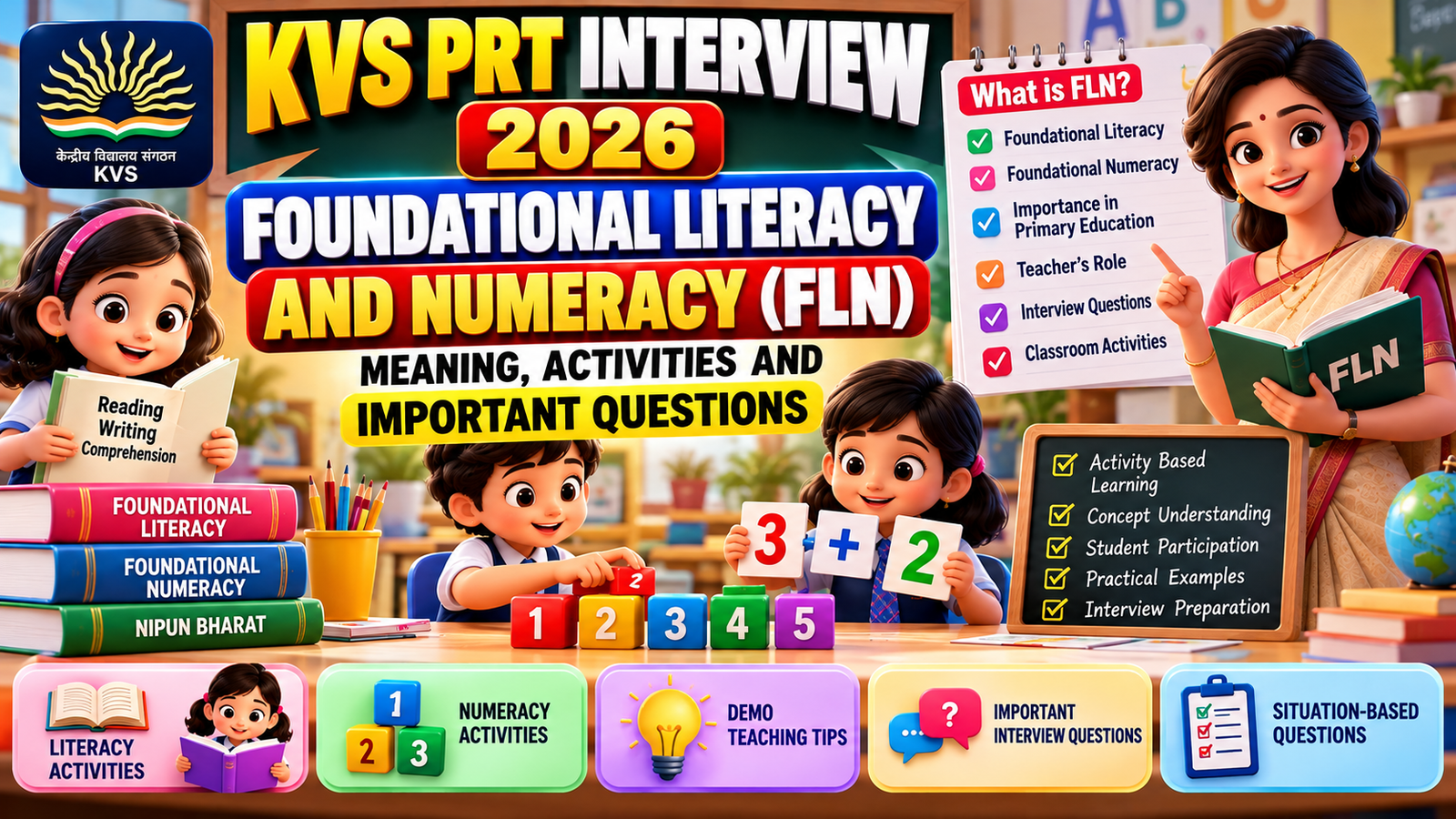
Preparing for the KVS PRT Interview 2026? One of the important topics for primary teacher candidates is Foundational Literacy and Numeracy (FLN). Understanding FLN, its classroom applications, and its role in children’s learning can help candidates prepare for subject-related and situation-based interview questions.
Foundational Literacy and Numeracy focuses on developing children’s basic reading, writing, comprehension, counting, and mathematical reasoning skills. These foundational abilities support further learning and help students participate more confidently in classroom activities.
In this blog, you will learn the meaning of FLN, foundational literacy activities, foundational numeracy activities, the teacher’s role, important KVS PRT interview questions and answers, and practical demo teaching tips.
What Is Foundational Literacy and Numeracy (FLN)?
Foundational Literacy and Numeracy (FLN) refers to the basic language and mathematical skills children need to support their future learning.
What Is Foundational Literacy?
Foundational literacy focuses on developing basic reading, writing, language understanding, and comprehension skills. It helps children understand written and spoken language, express their thoughts, and communicate effectively.
What Is Foundational Numeracy?
Foundational numeracy focuses on helping children understand numbers, counting, basic mathematical operations, patterns, measurement, and simple mathematical reasoning.
NEP 2020 identifies foundational literacy and numeracy as a high-priority area in school education. The NIPUN Bharat Mission aims to support the development of these essential skills in children. Its national framework links the foundational learning target for children to the end of Grade 3 and the 2026–27 timeframe.
Why Is FLN Important in Primary Education?
Foundational Literacy and Numeracy plays an important role in primary education because children need basic reading and mathematical skills to understand more advanced concepts.
When students can read with understanding, express their ideas, recognise numbers, and solve simple problems, they are better prepared to engage with different subjects and classroom activities.
Key Benefits of Foundational Literacy and Numeracy
- Reading fluency and comprehension: Helps students read and understand age-appropriate texts.
- Basic writing and language expression: Supports students in communicating their thoughts.
- Number recognition and counting: Develops an understanding of numbers and quantities.
- Basic mathematical operations: Builds the foundation for addition, subtraction, and other mathematical concepts.
- Logical thinking and reasoning: Encourages students to identify patterns and solve simple problems.
- Identification of learning gaps: Helps teachers recognise areas where students need additional support.
- Individualised learning support: Allows teachers to adapt activities according to students’ learning levels.
FLN is not limited to teaching children how to read words or count numbers. It also involves helping them understand concepts, express ideas, and apply their learning in simple situations.
Foundational Literacy Activities for Primary Classes
Teachers can use interactive and age-appropriate activities to make foundational literacy engaging and meaningful for students.
1. Picture Reading Activity
In this activity, teachers show students picture cards, illustrations, or images from a storybook.
Questions teachers can ask:
- “What can you see in this picture?”
- “What do you think is happening?”
- “Can you describe the picture in your own words?”
Learning outcome: This activity supports vocabulary development, observation, oral language, and communication skills.
2. Read-Aloud and Storytelling
Teachers can read short stories using expressive voices, suitable pauses, and clear pronunciation. After reading, students can discuss the characters, events, and message of the story.
Questions teachers can ask:
- Who was the main character in the story?
- What happened in the story?
- Which part did you find interesting?
- How would you change the ending of the story?
Learning outcome: Storytelling and read-aloud activities support listening skills, comprehension, imagination, and language development.
3. Letter and Word Recognition Activity
Teachers can use alphabet cards, familiar words, classroom labels, and picture cards to help students recognise letters and words.
For example, students can identify the names of familiar objects and connect letter sounds with words through guided practice.
Learning outcome: This activity supports letter recognition, sound awareness, vocabulary, and early reading skills.
4. Pair Reading Activity
In pair reading, students work in pairs to read short and age-appropriate texts. The teacher observes their reading and provides guidance wherever required.
Students should also be encouraged to listen patiently to their partners and help each other appropriately.
Learning outcome: Pair reading provides opportunities to practise reading fluency, listening, and collaborative learning.
5. Writing Through Daily Experiences
Teachers can encourage students to write simple sentences about familiar topics, such as:
- My School
- My Favourite Fruit
- My Classroom
- What I Did Today
Beginning writers can receive support through pictures, word banks, and sentence starters.
Learning outcome: This activity helps students practise sentence formation, vocabulary, written expression, and basic writing skills.
Foundational Numeracy Activities for Primary Classes
Foundational numeracy becomes easier to understand when children can connect numbers and mathematical concepts with objects, games, and familiar situations.
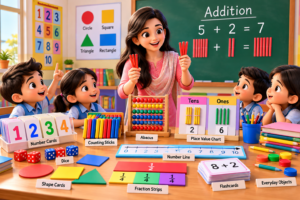
1. Counting with Real Objects
Teachers can provide students with beads, sticks, buttons, pencils, or other classroom objects for counting practice.
Example: “There are 8 pencils on the table. If we add 2 more pencils, how many pencils will there be in total?”
Students can count the objects, find the answer, and explain their reasoning.
Learning outcome: This activity develops number sense, counting skills, and an understanding of quantities.
2. Number Recognition Game
Teachers can display number cards and ask students to identify a particular number. The activity can also be reversed by showing a number card and asking students to say the number aloud.
Learning outcome: This game supports number recognition, visual identification, and the connection between number names and written numerals.
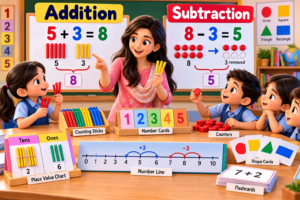
3. Teaching Addition and Subtraction Using Objects
Concrete objects help students understand basic mathematical operations before moving to abstract calculations.
Example 1: Addition
6 + 3 = 9
Place 6 objects on the table and add 3 more. Ask students to count all the objects to find the total.
Example 2: Subtraction
10 − 4 = 6
Place 10 objects on the table, remove 4, and ask students to count the remaining objects.
Learning outcome: These activities support conceptual understanding of addition and subtraction.
4. Shape Hunt Activity
Ask students to identify different shapes in their classroom or surroundings.
Examples:
- Clock – Circle
- Blackboard – Rectangle
- Window – Square or Rectangle, depending on its shape
- Pictures of traffic signs – Different geometric shapes
Encourage students to explain how they identified each shape.
Learning outcome: This activity develops shape recognition, observation, and the ability to connect geometry with everyday objects.
5. Pattern Completion Activity
Show students simple patterns and ask them to identify the next item.
Example 1: Red, Blue, Red, Blue, ___
Example 2: Circle, Square, Circle, Square, ___
Students can identify the next item and explain the pattern. Advanced learners can also create their own patterns.
Learning outcome: Pattern activities encourage logical thinking, observation, sequencing, and mathematical reasoning.
What Is the Role of a Teacher in FLN Development?
A teacher plays an important role in developing foundational literacy and numeracy skills. Since students learn at different speeds and have different learning needs, teachers should observe their progress and adapt teaching strategies accordingly.
Important Responsibilities of a Teacher in FLN
- Provide clear instructions: Use simple language and explain activities step by step.
- Use activity-based learning: Incorporate stories, games, objects, and practical demonstrations.
- Encourage student participation: Give students opportunities to ask questions and explain their thinking.
- Connect learning with familiar experiences: Use examples from students’ daily lives.
- Conduct regular assessments: Observe student performance and identify learning gaps.
- Provide additional support: Use guided practice and suitable activities for students who need help.
- Communicate with parents: Share constructive feedback and encourage appropriate learning practice at home.
The NIPUN Bharat framework also emphasises foundational skills, learning resources, teacher support, and monitoring students’ progress.
KVS PRT Interview 2026: Important FLN Questions and Answers
Candidates preparing for the KVS PRT Interview 2026 should practise explaining FLN concepts in simple language and connecting their answers with practical classroom examples.
Q1. What is FLN?
Answer: FLN stands for Foundational Literacy and Numeracy. It refers to the basic reading, writing, comprehension, and mathematical skills children need for further learning.
Q2. What is the NIPUN Bharat Mission?
Answer: NIPUN Bharat stands for the National Initiative for Proficiency in Reading with Understanding and Numeracy. It is a national mission focused on supporting children in developing foundational literacy and numeracy skills.
Q3. What is the role of activity-based learning in FLN?
Answer: Activity-based learning gives students opportunities to learn through participation, observation, practice, and exploration. For example, teachers can use number cards and classroom objects to teach counting and basic mathematical operations.
Q4. How will you teach a child who is struggling with basic counting?
Answer: First, I would observe the child’s current understanding of numbers and quantities. Then, I would use concrete objects, number cards, counting games, and guided practice. I would regularly monitor the child’s progress and provide additional support wherever needed.
Q5. How can you assess foundational literacy?
Answer: I would use reading observations, short oral questions, picture descriptions, word recognition tasks, and simple comprehension activities. The purpose of assessment would be to understand the student’s current learning level and identify areas requiring additional support.
Q6. How can you improve foundational numeracy?
Answer: I would use concrete objects, number lines, mathematical games, patterns, and real-life examples. I would also encourage students to explain how they arrived at an answer rather than focusing only on the final result.
Q7. What will you do if students in the same class have different learning levels?
Answer: I would prepare tasks of different difficulty levels according to students’ learning needs. Students requiring additional support would receive guided practice, while students who have already understood the concepts would receive extension activities.
Q8. How will you make FLN learning interesting?
Answer: I would use stories, games, rhymes, classroom objects, group activities, and real-life examples. I would select activities according to students’ age, learning levels, and lesson objectives.
Situation-Based FLN Interview Questions for KVS PRT
Situation-based questions assess how candidates apply educational concepts to real classroom challenges. Practising these questions can help candidates prepare clear, practical, and student-centred answers.
Situation 1: A student can read words but cannot understand a short paragraph. What will you do?
Sample Answer: I would start with short and familiar passages. After reading, I would ask simple comprehension questions and use pictures or classroom discussions to clarify the meaning. Once the student becomes more confident, I would gradually introduce more complex passages.
Situation 2: A student can count objects but struggles to identify written numbers. What will you do?
Sample Answer: I would connect object counting with number cards. I would ask the student to match quantities with the corresponding written numerals and provide repeated practice through games and interactive activities.
Situation 3: Some students finish a numeracy activity quickly, while others need more time. How will you manage the class?
Sample Answer: I would provide support according to each student’s learning level. Students who finish quickly would receive additional reasoning questions or extension tasks, while students who need more time would receive step-by-step guidance and guided practice.
FLN and KVS PRT Demo Teaching: Practical Preparation Tips
FLN-based demo teaching is an opportunity to demonstrate your understanding of foundational learning, classroom interaction, and age-appropriate teaching strategies.
How to Prepare an FLN-Based Demo Lesson
- Set a clear learning objective: Decide what students should know or be able to do by the end of the lesson.
- Select an age-appropriate activity: Choose a task that matches the students’ class level and learning needs.
- Prepare suitable teaching aids: Use objects, picture cards, number cards, charts, or other relevant materials.
- Use simple and familiar language: Explain the concept through examples students can understand.
- Encourage student interaction: Ask questions and give students opportunities to participate.
- Check learning outcomes: Prepare two or three short questions or tasks to assess understanding.
- Summarise the key concept: End the lesson by revising the main learning point.
Interview Tip: During your demo teaching, explain the learning objective, involve students in the activity, and check whether they have understood the concept. Focus on the learning process rather than simply completing the activity.
Official Resources for FLN and NEP 2020 Preparation
Candidates should refer to official sources for policy information and updates related to foundational literacy and numeracy.
- NIPUN Bharat Mission Portal: https://nipunbharat.education.gov.in/index.html
- National Education Policy 2020 – Ministry of Education: https://www.education.gov.in/sites/upload_files/mhrd/files/NEP_Final_English_0.pdf
Use these resources to review relevant policy concepts and verify official information before your interview.
KVS PRT Interview Preparation 2026 – TN Academy®
Preparing for the KVS PRT Interview 2026 requires a combination of subject knowledge, educational concepts, classroom application, demo teaching, communication skills, and mock interview practice.
At TN Academy® – Govt Job Coaching Institute, Bahadurgarh, candidates can enquire about interview preparation programmes and relevant batch details.
Trusted Education Brand | Education Legacy Since 14 March 2013
KVS PRT Interview Preparation 2026 – 4th Fresh Batch
Programme: 20-Day Intensive Module
KVS Special Educator PRT + TGT Interview Preparation 2026 – 5th Fresh Batch
Candidates preparing for Special Educator PRT and TGT interviews can contact the academy for relevant batch information and counselling.
Contact TN Academy® for Batch Details and Counselling
Call or WhatsApp: 9729299034
Tarun Dhankar Sir
Founder • Director • CEO, TN Academy®
Career Mentor | Interview Panelist | Mathematician
Prepare with clarity. Practise with purpose. Improve your interview performance.
TN Academy® provides interview preparation and training. Final selection depends on candidates’ performance and the official recruitment process.