KVS Interview 2026: NEP 2020 Important Questions and Answers for PRT Teachers
Preparing for the KVS PRT Interview 2026? One of the important topics to prepare is the National Education Policy (NEP) 2020. Candidates should understand the key concepts of the policy and learn how to apply them in a primary classroom.
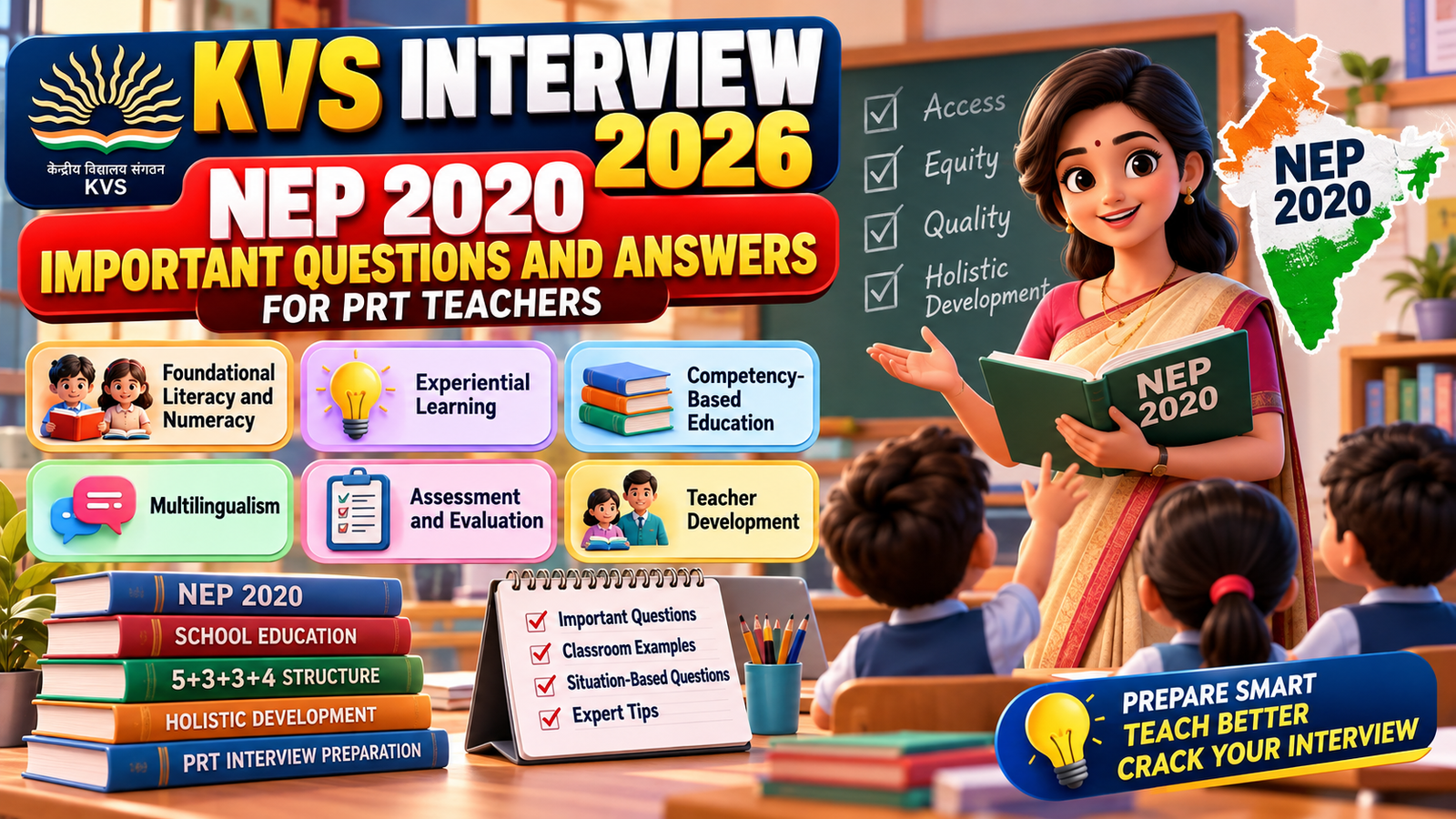
NEP 2020 focuses on foundational literacy and numeracy, experiential learning, competency-based education, multilingualism, holistic development, assessment reforms, and teacher development. During an interview, candidates may be asked about these concepts, their importance, and their practical application in teaching.
In this blog, we have covered NEP 2020 important questions and answers for the KVS PRT Interview 2026, along with classroom examples and situation-based questions to help candidates prepare effectively.
KVS PRT Interview 2026: NEP 2020 Important Questions and Answers
Q1. What is NEP 2020?
Answer: NEP 2020 stands for the National Education Policy 2020. It is a policy framework designed to transform education in India. It covers school education, higher education, teacher education, learning outcomes, and other important aspects of the education system.
Classroom Application: As a primary teacher, I would use activity-based teaching, interactive learning, and practical examples to help students understand concepts rather than simply memorising information.
Interview Tip: Keep your answer concise and connect the policy with your role as a primary teacher.
Q2. What are the main objectives of NEP 2020 in school education?
Answer: NEP 2020 aims to improve access, equity, quality, affordability, and accountability in education. It also emphasises conceptual understanding, critical thinking, experiential learning, foundational skills, and the holistic development of students.
Classroom Example: Instead of teaching mathematical formulas through memorisation alone, I would use objects, activities, and real-life examples to explain mathematical concepts.
Q3. What is the 5+3+3+4 curricular structure under NEP 2020?
Answer: NEP 2020 proposes a 5+3+3+4 curricular and pedagogical structure based on students’ developmental needs and learning stages.
The four stages are:
- Foundational Stage – 5 years: Three years of preschool or Anganwadi education and Classes 1–2.
- Preparatory Stage – 3 years: Classes 3–5.
- Middle Stage – 3 years: Classes 6–8.
- Secondary Stage – 4 years: Classes 9–12.
This structure aims to make education more developmentally appropriate and learner-centred.
Q4. What is experiential learning?
Answer: Experiential learning is an approach in which students learn through activities, observation, exploration, experiments, and real-life experiences.
Classroom Example: To teach fractions, I would use paper folding, fraction strips, or pictures of divided objects. These activities would help students understand fractions visually and practically.
Q5. What is the importance of Foundational Literacy and Numeracy (FLN)?
Answer: Foundational Literacy and Numeracy (FLN) refers to the basic reading, writing, comprehension, and mathematical skills that children need for further learning.
These skills provide the foundation for academic progress and help children participate confidently in classroom activities.
Classroom Example: I would provide regular opportunities for students to read short stories, answer comprehension questions, practise counting, recognise numbers, and solve basic mathematical problems.
Q6. What is competency-based education?
Answer: Competency-based education focuses on what students know, understand, and can do with their knowledge. It emphasises the practical application of concepts rather than memorisation alone.
Classroom Example: Instead of asking students only to recite multiplication tables, I would give them real-life word problems that require them to apply multiplication.
Q7. What is the role of multilingualism in primary education?
Answer: Multilingualism involves the meaningful use of multiple languages in learning. NEP 2020 encourages the use of the home language, mother tongue, or familiar language as a medium of instruction, wherever possible, particularly in the early years of education.
Using a familiar language can help students understand new concepts and participate more confidently in classroom activities.
Classroom Example: If students understand a mathematical concept more easily in their familiar language, I would use that understanding as a bridge to introduce the appropriate mathematical vocabulary.
Q8. What is the difference between rote learning and conceptual learning?
Answer: Rote learning focuses mainly on memorising information, whereas conceptual learning focuses on understanding ideas and applying knowledge in different situations.
Classroom Example: Memorising multiplication tables is an example of rote practice. Understanding multiplication through equal groups, repeated addition, and practical activities supports conceptual learning.
Q9. What is holistic development under NEP 2020?
Answer: Holistic development focuses on the overall development of students, including their intellectual, physical, social, emotional, creative, and ethical growth.
Classroom Example: I would include problem-solving activities, teamwork, art, physical activities, classroom discussions, and opportunities for communication to support students’ overall development.
Q10. How can you implement NEP 2020 in a primary classroom?
Answer: I would implement NEP 2020 by using activity-based teaching, experiential learning, conceptual explanations, student participation, inclusive teaching practices, and regular formative assessment.
I would also identify students’ learning needs and modify my teaching strategies accordingly.
Classroom Example: While teaching addition, I would use counters, number lines, and real-life examples to help students understand the concept before moving to written calculations.
Q11. What is formative assessment?
Answer: Formative assessment is an ongoing process used to understand students’ progress during teaching and learning. It helps teachers identify learning gaps, provide feedback, and improve teaching strategies.
Classroom Examples:
- Asking short oral questions.
- Conducting classroom activities.
- Using worksheets and observation.
- Asking students to explain their answers.
- Conducting exit-ticket activities at the end of a lesson.
Q12. What is the role of a teacher under NEP 2020?
Answer: Under NEP 2020, a teacher is not merely an information provider but also a facilitator, mentor, and guide. Teachers support students in exploring ideas, asking questions, developing critical thinking, and understanding concepts.
A teacher should create an inclusive, engaging, and supportive learning environment that addresses the diverse needs of students.
Classroom Example: Instead of directly providing every answer, I would encourage students to explore different solutions, discuss their reasoning, and learn through guided activities.
NEP 2020 Interview Questions: Situation-Based Practice for KVS PRT
Situation-based questions help interviewers understand how candidates apply educational principles in real classroom situations. Practise the following questions with clear, practical answers.
Situation 1: Some students in your class are weak in reading. What will you do?
Sample Answer: First, I would assess the students’ current reading levels and identify their specific difficulties. I would then use picture cards, phonics-based activities, short stories, and guided reading exercises. I would provide individual support, regular feedback, and opportunities for reading practice to monitor their progress.
Situation 2: Students memorise mathematical formulas but cannot solve problems. What will you do?
Sample Answer: I would focus on conceptual understanding by using concrete objects, diagrams, and real-life examples. I would demonstrate the problem-solving process step by step and encourage students to solve similar problems independently. I would also ask them to explain their reasoning to check their understanding.
Situation 3: Students in your classroom have different learning levels. How will you plan your lesson?
Sample Answer: I would plan activities and questions with different levels of difficulty. Students who need additional support would receive simpler explanations and guided practice, while advanced learners would receive extension activities. This would help me address individual learning needs and encourage participation from every student.
Situation 4: You realise that students have not understood your lesson. What will you do?
Sample Answer: I would conduct a quick formative assessment to identify the areas of difficulty. Based on the students’ responses, I would explain the concept again using simpler steps, visual aids, practical demonstrations, and alternative examples. I would then check their understanding before moving to the next topic.
KVS PRT Interview 2026: NEP 2020 Preparation Tips
Follow these preparation tips to answer NEP 2020 questions confidently during your KVS PRT interview.
- Understand the key concepts: Focus on FLN, experiential learning, competency-based education, multilingualism, assessment, and holistic development.
- Prepare classroom examples: Connect every major concept with a practical primary teaching example.
- Keep answers clear and concise: Avoid unnecessarily lengthy definitions and focus on the main points.
- Practise situation-based questions: Prepare answers for classroom management, mixed learning levels, learning difficulties, and assessment.
- Focus on student-centred teaching: Explain how your teaching methods will improve students’ understanding and participation.
- Revise the 5+3+3+4 structure: Remember the four stages and their corresponding classes.
- Verify official information: Check policy details, implementation updates, and relevant guidelines through official government sources.
Official Resources for NEP 2020 Preparation
For authentic information and further preparation, candidates can refer to:
- Ministry of Education: National Education Policy 2020 and related educational resources.
- NIPUN Bharat Mission: Official resources on foundational literacy and numeracy.
Always verify policy-related facts and the latest implementation updates using official sources before your interview.
KVS PRT Interview Preparation 2026 – TN Academy®
Preparing for the KVS PRT Interview 2026 requires more than theoretical knowledge. Candidates should also practise demo teaching, classroom-based questions, communication skills, and mock interviews.
TN Academy® – Govt. Job Coaching Institute, Bahadurgarh
Trusted Education Brand | Education Legacy Since 14 March 2013
KVS PRT Interview Preparation 2026 – 4th Fresh Batch
Programme: 20-Day Intensive Module
Prepare for your interview with a structured approach that focuses on educational concepts, classroom application, interview practice, and performance improvement.
KVS Special Educator PRT + TGT Interview Preparation 2026 – 5th Fresh Batch
Candidates preparing for Special Educator PRT and TGT interviews can enquire about the relevant batch details and counselling.
Contact TN Academy® for Batch Details and Counselling
Call or WhatsApp: 9729299034
Tarun Dhankar Sir
Founder • Director • CEO, TN Academy®
Career Mentor | Interview Panelist | Mathematician
Prepare with clarity. Practise with purpose. Improve your interview performance.
TN Academy® provides interview preparation and training. Final selection depends on candidates’ performance and the official recruitment process.