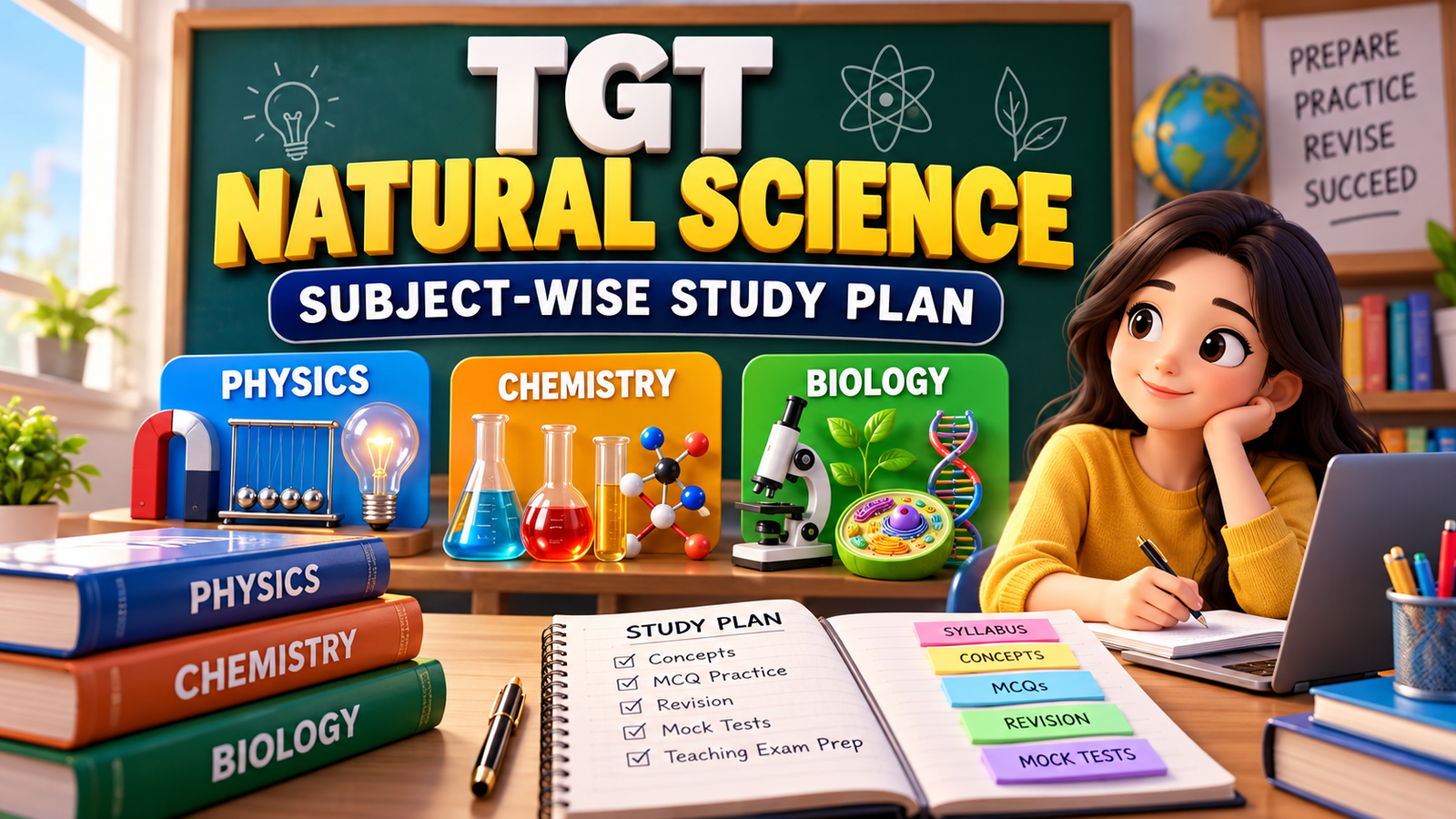
TGT Natural Science Preparation 2026: Subject-Wise Study Plan, Syllabus & MCQ Practice
Introduction: How to Prepare for TGT Natural Science?
TGT Natural Science preparation requires a systematic approach to Physics, Chemistry and Biology. Candidates preparing for teaching recruitment examinations need to focus on conceptual understanding, subject-wise revision, objective questions, numerical problems, diagrams and regular mock-test practice.
Whether you are preparing for DSSSB TGT Natural Science or another relevant TGT Science recruitment examination, an organised study plan can help you cover important topics, identify weak areas and improve your accuracy.
The first step is to understand the latest official syllabus for your target examination. After that, divide your preparation into manageable subject-wise targets and follow a consistent revision schedule.
In this guide, you will learn how to prepare for Physics, Chemistry and Biology, organise weekly study sessions, practise TGT Science MCQs and evaluate your preparation through mock tests.
1. Understand the TGT Natural Science Syllabus
Before starting your TGT Science preparation, check the latest official notification, eligibility requirements, examination pattern and subject-specific syllabus for your target post.
For initial planning, you can divide Natural Science preparation into three broad subject areas.
Physics: Important Topics for Revision
- Motion, Force and Laws of Motion
- Work, Energy and Power
- Heat and Temperature
- Light and Sound
- Electricity and Magnetism
Chemistry: Important Topics for Revision
- Matter and Its Properties
- Atoms and Molecules
- Chemical Reactions and Equations
- Acids, Bases and Salts
- Metals and Non-Metals
- Carbon Compounds
Biology: Important Topics for Revision
- Cell Structure and Functions
- Human Physiology
- Plant Structure and Physiology
- Reproduction and Heredity
- Ecology and Environment
These are broad revision categories, not a complete official syllabus. The actual topics, difficulty level and coverage may differ between recruitment examinations.
Preparation tip: Create a checklist from the official syllabus and mark every topic as Not Started, In Progress or Revised. This will help you track your progress and avoid repeatedly studying familiar topics while leaving important areas incomplete.
2. TGT Natural Science Physics Preparation Strategy
Physics preparation requires conceptual clarity, familiarity with formulas and consistent numerical practice. Simply memorising definitions and formulas may not be sufficient to solve application-based questions.
Follow this step-by-step Physics preparation strategy:
- Understand the concepts: Study the basic principles, definitions and laws before attempting difficult questions.
- Prepare formula notes: Record important formulas, SI units, symbols and relevant conditions for their application.
- Practise solved examples: Understand how a formula or scientific principle is applied to a problem.
- Attempt topic-wise MCQs: Solve conceptual questions and numerical problems after completing each topic.
- Review incorrect answers: Identify whether the mistake occurred because of a conceptual gap, incorrect calculation or misunderstanding of the question.
How to Improve Physics Accuracy
Maintain a separate formula notebook and an error log. When you answer a question incorrectly, write down the correct concept and solve a similar question.
Revise the formulas regularly and practise timed question sets to improve your speed without compromising accuracy.
3. TGT Natural Science Chemistry Preparation Strategy
Chemistry preparation becomes more manageable when topics are organised into concepts, reactions, equations and examples.
Start with the fundamentals and gradually move towards more complex topics included in your target examination’s syllabus.
Important Areas to Cover
- Properties and classification of matter
- Atomic structure and chemical bonding, where prescribed
- Atoms, molecules and chemical equations
- Types of chemical reactions
- Acids, bases and salts
- Metals, non-metals and their properties
- Carbon compounds and related concepts
Effective Chemistry Study Method
Step 1: Prepare topic-wise notes. Record definitions, properties, reactions and important examples in a structured format.
Step 2: Practise chemical equations. Learn to write and balance equations wherever relevant to the syllabus.
Step 3: Use comparison tables. Compare similar concepts, properties and reactions to make revision easier.
Step 4: Solve TGT Science MCQs. Attempt objective questions after completing each chapter.
Step 5: Revise weak topics. Revisit incorrect answers and practise additional questions on the same concepts.
Avoid studying every topic with equal depth without checking the prescribed syllabus. Prioritise topics according to their relevance to your target examination.
4. TGT Natural Science Biology Preparation: Diagrams and Concepts
Biology preparation involves understanding structures, biological processes, relationships and scientific terminology. Visual notes and labelled diagrams can make complex concepts easier to revise.
Important Biology Preparation Areas
- Cell structure and cell functions
- Human body systems and physiology
- Plant structure and physiology
- Reproduction and heredity
- Ecology and environmental concepts
How to Study Biology Effectively
Use labelled diagrams: Practise drawing and identifying important biological structures wherever required.
Create process flowcharts: Represent biological processes in a logical sequence to understand how different stages are connected.
Prepare comparison tables: Compare similar structures, processes and functions to improve conceptual clarity.
Revise scientific terminology: Maintain concise notes of important terms, definitions and examples.
Practise chapter-wise MCQs: Use objective questions to check your understanding after completing each topic.
Instead of repeatedly reading long chapters, prepare short revision notes and revisit them at regular intervals. This can help you identify gaps in your understanding before attempting a mock test.
5. Prepare for Other Sections of the TGT Recruitment Examination
TGT Natural Science preparation should not be planned entirely around Physics, Chemistry and Biology if your target examination includes additional sections.
Recruitment examinations such as DSSSB, KVS, NVS and EMRS may have different examination structures, section weightages and selection requirements. Candidates should check the applicable official notification rather than assuming that every examination follows the same pattern.
Depending on your target examination, your preparation may also need to include:
- General Awareness
- Reasoning Ability
- Language sections
- Teaching aptitude or pedagogy, where prescribed
- Other examination-specific components
Allocate study time according to the official examination pattern and your individual performance. If a particular section is affecting your overall mock-test score, include additional practice for that section in your weekly plan.
6. TGT Natural Science Weekly Study Plan
A weekly timetable can help you balance all three science subjects while maintaining regular revision and practice.
| Day | Study Plan | Practice Target |
|---|---|---|
| Monday | Physics concepts and formulas | Physics MCQs and numerical questions |
| Tuesday | Chemistry concepts and reactions | Chemistry MCQs |
| Wednesday | Biology concepts and diagrams | Biology MCQs |
| Thursday | Physics and Chemistry revision | Mixed subject questions |
| Friday | Biology revision and weak topics | Topic-wise practice |
| Saturday | Timed sectional test | Accuracy and time management |
| Sunday | Mock-test analysis and revision | Reattempt incorrect questions |
How to Use This Study Plan
- Set realistic daily targets based on your available study hours.
- Complete concept learning before moving to advanced question practice.
- Give extra time to subjects in which your accuracy is low.
- Review your weekly progress every Sunday.
- Keep some time available for unfinished topics and revision.
You can adjust the timetable according to your preparation level, examination date and the syllabus of your target recruitment examination.
7. TGT Science MCQ Practice and Mock-Test Strategy
Regular MCQ practice is an important part of TGT Natural Science preparation. It helps you assess your understanding, recognise recurring mistakes and become familiar with objective question formats.
However, solving a large number of questions without analysing the answers may not address your weak areas.
Follow This MCQ Practice Method
1. Start with topic-wise questions. Complete a set of MCQs after studying each chapter.
2. Move to mixed question sets. Combine questions from Physics, Chemistry and Biology to test your ability to switch between subjects.
3. Attempt timed sectional tests. Practise answering questions within a defined time limit.
4. Analyse your performance. Record your score, accuracy, time taken and incorrect answers.
5. Reattempt difficult questions. Solve previously incorrect questions after revising the relevant concepts.
What Should You Analyse After a Mock Test?
- Which topics produced the most incorrect answers?
- Were the mistakes caused by weak concepts or calculation errors?
- Did you spend too much time on particular questions?
- Which chapters require additional revision?
- Has your accuracy improved compared with previous tests?
Maintain a simple performance tracker after every test. Reviewing your progress over several weeks can help you make better decisions about where to focus your study time.
8. Revision Strategy for TGT Natural Science
Revision should be part of your preparation from the beginning rather than something you start just before the examination.
A practical revision system can include three activities:
Daily revision: Review formulas, definitions, diagrams and key concepts studied that day.
Weekly revision: Revisit important topics from all three science subjects and solve mixed MCQs.
Periodic revision: Reattempt incorrect questions, revise weak chapters and complete timed tests.
You can also maintain three separate notebooks:
- Physics formulas and numerical mistakes
- Chemistry reactions, properties and difficult concepts
- Biology diagrams, terminology and important processes
Keep these notes concise and easy to review. Update them whenever a mock test reveals a new weakness.
9. TGT Science Coaching in Bahadurgarh
Candidates looking for structured guidance for teaching recruitment examinations can compare coaching options based on faculty experience, subject coverage, study material, doubt-solving support and test schedules.
TN Academy® is a government job coaching institute in Bahadurgarh, Delhi NCR. Candidates interested in DSSSB, KVS, NVS and EMRS preparation can enquire about the availability and structure of relevant courses.
Before enrolling, confirm the current batch schedule, subjects covered, course format, fee structure and examination-specific preparation support.
Course Enquiry and Counselling
For information about relevant teaching-exam preparation courses, contact TN Academy® using the details below.
Call/WhatsApp: 9729299034
Website: https://tnacademy.in/dsssb-kvs-nvs-emrs-coaching-bahadurgarh/
When making an enquiry, mention your target examination, subject and expected examination timeline so that the available course information can be checked against your requirements.
10. Common Mistakes to Avoid During TGT Natural Science Preparation
Even a well-planned study schedule can become ineffective if you do not evaluate your progress regularly.
Avoid these common preparation mistakes:
Ignoring the official syllabus: Studying unrelated topics can waste valuable preparation time.
Focusing only on theory: Conceptual learning should be supported by MCQs, numerical questions and topic-wise practice.
Memorising formulas without application: Practise using formulas in different types of questions.
Neglecting Biology diagrams: Include diagram-based revision wherever relevant to your syllabus.
Skipping mock-test analysis: Your mistakes can reveal which concepts need additional attention.
Using the same timetable for every examination: Adjust your plan according to the applicable examination pattern and your performance.
Postponing revision: Review previously studied topics regularly instead of depending entirely on last-minute preparation.
A consistent approach to learning, practice and error correction can make your preparation more organised and measurable.
Frequently Asked Questions (FAQs)
Q1. How should I start TGT Natural Science preparation?
Start by checking the latest official syllabus and examination pattern for your target post. Divide the prescribed topics into Physics, Chemistry and Biology, then create a weekly plan that combines concept learning, MCQ practice and revision.
Q2. Which subjects should I study for TGT Natural Science?
Physics, Chemistry and Biology are the three broad subject areas covered in Natural Science preparation. The exact topics and depth depend on the relevant recruitment examination and its prescribed syllabus.
Q3. Should I study Physics, Chemistry and Biology every day?
You can follow a daily rotation or an alternate-day schedule. The important thing is to maintain consistent coverage of all three subjects and revise previously studied topics regularly.
Q4. How many MCQs should I solve daily for TGT Science?
There is no single daily question target that suits every candidate. Begin with a manageable number of questions, review your mistakes and gradually increase practice according to your preparation level and available time.
Q5. Is the DSSSB TGT Science syllabus the same as the KVS TGT syllabus?
Do not assume that the two examinations have identical syllabi or examination patterns. Check the latest official notification and applicable syllabus for each recruitment examination separately.
Q6. How can I improve my TGT Science mock-test score?
Analyse incorrect answers, identify weak topics, revise the relevant concepts and reattempt similar questions. Track accuracy and time taken across multiple tests to evaluate your progress.
Q7. Where can I enquire about TGT Science coaching in Bahadurgarh?
You can contact TN Academy® at 9729299034 by call or WhatsApp to enquire about relevant teaching-exam courses, current batches and course details.
Conclusion
TGT Natural Science preparation becomes easier to organise when you divide the syllabus into manageable topics and follow a consistent study routine. Focus on conceptual understanding in Physics, systematic revision in Chemistry, visual learning in Biology and regular objective question practice across all three subjects.
Use weekly targets, timed tests and error analysis to identify your weak areas and adjust your preparation strategy. Most importantly, follow the official syllabus and examination pattern for your target recruitment examination.
If you are exploring teaching-exam coaching in Bahadurgarh, you can contact TN Academy® at 9729299034 to enquire about relevant courses and current batch availability.

You may also like
DSSSB TGT Mathematics: Syllabus and Preparation Strategy