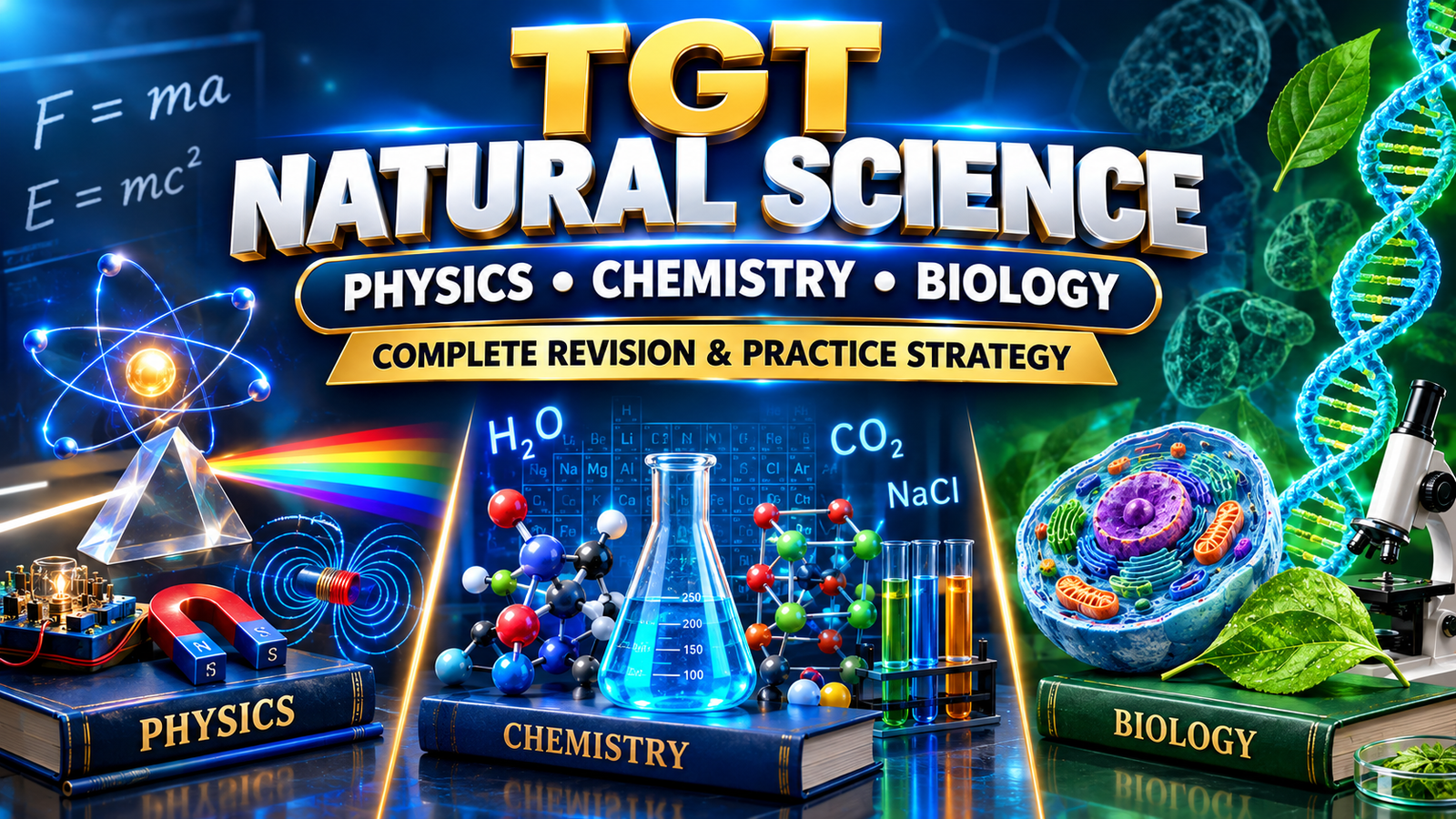
TGT Natural Science: Physics, Chemistry and Biology Revision Guide
Introduction: How to Prepare for TGT Natural Science
Preparing for a TGT Natural Science examination requires a strong understanding of scientific concepts, regular revision and the ability to apply theoretical knowledge to practical and examination-based questions.
Candidates preparing for science teacher recruitment should organise their study plan around Physics, Chemistry and Biology. A subject-wise approach makes it easier to revise important concepts, practise questions, identify weak areas and improve overall preparation.
An effective TGT Natural Science preparation strategy should include:
- Revising important concepts and definitions from Physics, Chemistry and Biology.
- Learning scientific laws, formulas, chemical reactions and biological processes.
- Practising conceptual, numerical and application-based questions.
- Revising labelled diagrams, scientific terminology and important examples.
- Attempting syllabus-aligned mock tests and analysing mistakes.
- Developing the ability to explain scientific concepts clearly.
Important: The exact syllabus, subject combination, eligibility criteria and examination pattern may vary between recruiting authorities. Always consult the applicable official recruitment notification before finalising your preparation plan.
1. Physics Revision for TGT Natural Science
Physics explains the fundamental principles governing motion, force, energy, light, sound, electricity and other physical phenomena. Candidates should focus on understanding scientific laws, remembering relevant formulas and applying concepts to numerical and conceptual questions.
Important Physics Topics for TGT Science Preparation
Revise the topics prescribed in your examination syllabus, including:
- Motion, speed, velocity and acceleration.
- Force and Newton’s laws of motion.
- Work, energy and power.
- Heat, temperature and transfer of heat.
- Light, reflection and refraction.
- Sound and wave properties.
- Electricity, electric circuits and resistance.
- Magnetism and electromagnetic concepts, where prescribed.
- Units, measurements and physical quantities.
How to Revise Physics Effectively
1. Understand the concepts: Learn the meaning of each physical quantity and the relationship between different variables.
2. Revise important formulas: Maintain a formula notebook containing definitions, SI units and relevant equations.
3. Practise numerical questions: Solve problems step by step, including unit conversions and calculations.
4. Connect concepts with daily life: Use familiar examples to understand motion, friction, energy, sound and electrical circuits.
TGT Natural Science Practice Questions: Physics
Question 1: What is the SI unit of force?
Answer: Newton (N).
Question 2: What is the SI unit of power?
Answer: Watt (W).
Question 3: Which type of lens is commonly used as a magnifying glass?
Answer: A convex lens.
Question 4: What is the SI unit of electric resistance?
Answer: Ohm (Ω).
Question 5: Which law explains the relationship between force, mass and acceleration?
Answer: Newton’s second law of motion, expressed as (F=ma) for a constant-mass body in the standard classical formulation.
Physics Preparation Tip: Do not rely on memorising formulas alone. Practise questions that test conceptual understanding, formula application and correct use of SI units.
2. Chemistry Revision for TGT Natural Science
Chemistry deals with the composition, properties, structure and transformations of matter. For effective TGT Science preparation, candidates should understand chemical concepts, recognise symbols and formulas, and revise important reactions and their applications.
Important Chemistry Topics for TGT Science Preparation
Focus on the relevant topics listed in the official syllabus, such as:
- Matter and its physical and chemical properties.
- Atoms, molecules and atomic structure.
- Elements, compounds and mixtures.
- Chemical reactions and balanced chemical equations.
- Acids, bases and salts.
- Metals and non-metals.
- Carbon compounds and their properties, where prescribed.
- Periodic classification of elements.
- Separation of mixtures and other prescribed laboratory-related concepts.
How to Revise Chemistry Effectively
1. Learn scientific terminology: Understand the definitions of atoms, molecules, elements, compounds and mixtures.
2. Practise chemical equations: Learn to identify reactants and products and balance equations where required.
3. Revise important formulas: Create a list of common chemical formulas, symbols and reactions included in your syllabus.
4. Understand reactions: Focus on why a reaction occurs and what products may form rather than memorising isolated statements.
5. Use comparison tables: Compare acids and bases, metals and non-metals, and physical and chemical changes.
TGT Natural Science Practice Questions: Chemistry
Question 1: What is the chemical formula of common salt?
Answer: NaCl.
Question 2: What is the pH of a neutral aqueous solution at approximately 25°C?
Answer: 7.
Question 3: Which gas is commonly released when many metals react with dilute acids?
Answer: Hydrogen gas, depending on the metal and reaction conditions.
Question 4: What is the smallest unit of an element that retains its chemical identity?
Answer: An atom.
Question 5: What is the chemical formula of water?
Answer: H₂O.
Chemistry Preparation Tip: Revise chemical symbols, formulas, reaction types and important definitions regularly. Practise conceptual questions alongside direct fact-based questions to strengthen understanding.
3. Biology Revision for TGT Natural Science
Biology is the study of living organisms, their structures, functions, growth, reproduction and interactions with the environment. A systematic revision strategy can help candidates understand biological processes and remember important scientific terminology.
Important Biology Topics for TGT Science Preparation
Depending on the applicable syllabus, revise:
- Cell structure and functions.
- Plant and animal tissues.
- Human body systems.
- Nutrition and digestion.
- Respiration and circulation.
- Plant structure and physiology.
- Photosynthesis and transport in plants.
- Reproduction in plants and animals.
- Heredity and evolution.
- Ecology and environmental conservation.
- Health, disease and immunity.
How to Revise Biology Effectively
1. Practise labelled diagrams: Revise the structure of cells, organs and other important biological components.
2. Understand biological processes: Learn the stages and functions involved in processes such as digestion, respiration and photosynthesis.
3. Prepare comparison tables: Compare plant and animal cells, aerobic and anaerobic respiration, and other relevant concepts.
4. Make concise revision notes: Record important definitions, functions, examples and differences.
5. Revise scientific terminology: Pay attention to the correct names of structures, processes and biological classifications.
TGT Natural Science Practice Questions: Biology
Question 1: Which organelle is commonly called the powerhouse of the cell?
Answer: Mitochondrion.
Question 2: Which pigment absorbs light for photosynthesis in green plants?
Answer: Chlorophyll.
Question 3: What is the basic structural and functional unit of life?
Answer: The cell.
Question 4: Which blood cells primarily help defend the body against infections?
Answer: White blood cells, also called leukocytes.
Question 5: Which process allows green plants to prepare food using light energy?
Answer: Photosynthesis.
Biology Preparation Tip: Combine reading with diagram practice and active recall. Explaining a biological process in your own words can help you identify gaps in understanding.
4. How to Prepare for Science Teaching Concepts
Science teacher recruitment may require candidates to demonstrate subject knowledge and the ability to explain concepts clearly. Depending on the recruitment process, teaching demonstrations or interviews may also be relevant.
Important Science Teaching Skills
1. Explain Physics with everyday examples: Use familiar situations to explain force, motion, energy and sound.
2. Demonstrate Chemistry concepts safely: Explain acids, bases and chemical reactions through appropriate examples. Any practical demonstration should follow suitable safety precautions and supervision.
3. Use diagrams in Biology: Explain photosynthesis, cell structure and human body systems through clear, labelled illustrations.
4. Use simple language: Break complex scientific ideas into smaller, understandable steps.
5. Encourage active learning: Ask questions that help learners predict outcomes, explain observations and apply scientific principles.
6. Check understanding: Use short questions or examples to determine whether learners have understood the concept.
How to Structure a Science Demonstration Lesson
If a teaching demonstration is part of your recruitment process, practise the following sequence:
- Introduce the topic and state the learning objective.
- Connect the concept with prior knowledge or a familiar example.
- Explain the scientific principle step by step.
- Use a diagram, model or suitable demonstration.
- Ask questions to encourage student participation.
- Summarise the key points and assess understanding.
A strong science teacher combines subject knowledge with clear communication, logical explanation and the ability to make scientific concepts accessible to learners.
5. Subject-Wise Strategy for TGT Natural Science Preparation
An organised study routine helps candidates cover the prescribed syllabus without overlooking important concepts.
Step 1: Analyse the Official Syllabus
Identify the topics included in the relevant recruitment notification. Organise them into Physics, Chemistry and Biology wherever applicable.
Classify each topic as:
- Strong: Concepts are clear and practice questions can be solved confidently.
- Moderate: Basic understanding exists, but further revision is required.
- Weak: Concepts need additional study and guided practice.
Prioritise weak topics while continuing regular revision of stronger areas.
Step 2: Revise Concepts Before Practising Questions
Review definitions, formulas, laws, chemical equations, diagrams and scientific processes before attempting difficult questions.
This approach helps you understand why an answer is correct instead of relying entirely on memorisation.
Step 3: Practise Different Types of Questions
Include the following question types wherever relevant to the examination:
- Direct concept-based questions.
- Numerical and calculation-based questions.
- Scientific reasoning questions.
- Diagram-based questions.
- Application-based and everyday science questions.
- Mixed-topic practice questions.
Step 4: Maintain a Mistake Notebook
Record incorrect answers and identify the reason behind each mistake.
Common reasons include:
- Forgetting a scientific formula.
- Confusing similar definitions.
- Applying the wrong principle.
- Making calculation errors.
- Misinterpreting a question.
- Forgetting a biological process or chemical reaction.
Review this notebook during weekly revision.
Step 5: Attempt a TGT Science Mock Test
A syllabus-aligned TGT Science mock test can help assess your preparation, accuracy and time management.
After each test:
- Review incorrect and unanswered questions.
- Identify the concepts responsible for mistakes.
- Revise the relevant subject.
- Practise similar questions.
- Track your performance over time.
Use a mock-test format based on the applicable recruitment examination rather than an unrelated examination pattern.
6. Suggested Seven-Day TGT Natural Science Revision Plan
Use the following sample schedule to organise your revision across Physics, Chemistry and Biology.
Day 1: Physics Fundamentals
- Revise motion, force, work, energy and power.
- Review definitions, formulas and SI units.
- Practise basic conceptual questions.
Day 2: Physics Practice
- Revise light, sound, electricity and other prescribed topics.
- Solve numerical and application-based questions.
- Review incorrect answers.
Day 3: Chemistry Concepts
- Revise atoms, molecules, matter and chemical reactions.
- Review important chemical formulas and equations.
- Practise concept-based questions.
Day 4: Chemistry Practice
- Revise acids, bases, salts, metals and other applicable topics.
- Practise chemical equations and comparison questions.
- Review difficult concepts.
Day 5: Biology Revision
- Revise cell structure, human physiology and plant biology.
- Practise labelled diagrams.
- Review definitions and biological processes.
Day 6: Mixed Subject Practice
- Solve questions from Physics, Chemistry and Biology.
- Identify weak topics.
- Revise important formulas, reactions and diagrams.
Day 7: Mock Test and Error Analysis
- Attempt a syllabus-aligned mock test.
- Review incorrect and time-consuming questions.
- Create a priority list for the next revision cycle.
Note: This is a suggested revision framework, not an official examination timetable. Adapt it according to your syllabus, preparation level and available study time.
7. Common Mistakes to Avoid During TGT Science Preparation
Candidates can improve their preparation by avoiding the following mistakes.
1. Memorising Formulas Without Understanding Concepts
Understand the meaning and application of scientific formulas before attempting complex questions.
2. Ignoring Diagrams and Scientific Processes
Diagrams can help reinforce understanding of biological structures, physical systems and other visual concepts.
3. Studying Only Familiar Topics
Allocate revision time according to syllabus coverage and topic difficulty instead of repeatedly studying only your strongest areas.
4. Skipping Application-Based Questions
Practise questions that require scientific reasoning and the application of concepts, wherever relevant to the examination.
5. Taking Mock Tests Without Reviewing Errors
A mock test is most useful when you analyse incorrect answers and revise the concepts responsible for mistakes.
6. Following the Wrong Recruitment Syllabus
KVS, DSSSB and state recruitment authorities may have different requirements. Verify the correct notification before preparing a final topic checklist.
7. Neglecting Regular Revision
Revisit important definitions, formulas, chemical equations, diagrams and previously incorrect questions at regular intervals.
8. Frequently Asked Questions About TGT Natural Science Preparation
Q1. How should I prepare for TGT Natural Science?
Start by reviewing the official syllabus and examination pattern. Divide the prescribed topics into suitable subject areas, revise concepts systematically and practise questions regularly.
Q2. Which subjects should I revise for TGT Natural Science?
The preparation may involve Physics, Chemistry and Biology, depending on the applicable subject combination and recruitment requirements. Follow the official notification to determine the exact syllabus.
Q3. Should I practise numerical questions for TGT Science?
Yes, wherever numerical and calculation-based questions are relevant to the prescribed syllabus. Practise the correct use of formulas, units and calculation steps.
Q4. Are diagrams important for science teacher recruitment?
Diagrams can help strengthen conceptual understanding and are useful for explaining biological structures, scientific processes and physical systems. Their examination relevance depends on the applicable assessment format.
Q5. How can I improve my TGT Science mock-test performance?
Analyse incorrect answers, identify weak topics, revise the relevant concepts and practise similar questions. Track accuracy and time management across successive tests.
Q6. Where can I check the official TGT Natural Science syllabus?
Consult the recruitment notification published by the relevant authority, such as Kendriya Vidyalaya Sangathan (KVS), Delhi Subordinate Services Selection Board (DSSSB) or the applicable state recruitment board.
Official websites:
Always use the notification applicable to your target recruitment examination.
9. TGT Natural Science Preparation Guidance at TN Academy®
TN Academy® is a Government Job Coaching Institute located in Bahadurgarh, Haryana. Teaching-recruitment aspirants can contact the academy to enquire about relevant preparation programmes, subject-wise study support and available batches.
Candidates interested in TGT Science preparation can ask about applicable courses, Physics, Chemistry and Biology revision support, practice sessions and mock-test guidance.
Contact TN Academy®
Institute: TN Academy® — Government Job Coaching Institute
Address: 3rd Floor, Radha Ganga Arcade, Opp. Jhajjar Mod, Delhi–Rohtak Road, Metro Pillar 848, Bahadurgarh, Haryana 124507.
Call/WhatsApp: 9729299034
Website: https://tnacademy.in/
Contact the academy to confirm whether a relevant Natural Science batch is currently available. Verify faculty availability, course coverage, fees, timetable and demo-class options before enrolment.
Conclusion
Effective TGT Natural Science preparation requires conceptual clarity, regular revision and consistent practice across the prescribed subject areas. A structured approach to Physics, Chemistry and Biology can help candidates strengthen scientific understanding, improve accuracy and prepare more systematically for teaching recruitment examinations.
Begin with the official syllabus, revise important concepts, practise application-based questions and use mock tests to identify areas for improvement. Alongside subject knowledge, develop the ability to explain scientific concepts clearly and confidently.
Disclaimer: This article provides general educational and examination preparation guidance. The applicable official recruitment notification determines the syllabus, eligibility criteria, examination pattern and selection process. Course availability and other details at TN Academy® should be confirmed directly with the institute.

You may also like

TGT Hindi Grammar: Important Rules and Practice Questions