KVS Interview 2026: Practical IEP Example for Teachers | Individualized Education Plan
IEP Kya Hai? KVS Interview 2026 Ke Liye Simple Explanation
KVS PRT Interview 2026 aur KVS Special Educator Interview 2026 ki preparation karte waqt IEP (Individualized Education Program) ek important topic hai. Yeh topic especially inclusive education, individual learning needs, classroom support aur student assessment se related interview questions ke liye useful hai.
IEP stands for Individualized Education Program. It is a structured educational plan designed to address an eligible student’s individual learning needs, educational goals, required support and progress.
Simple words mein, IEP ek aisa plan hai jisme teacher aur relevant team student ki current learning level ko understand karke suitable educational goals aur teaching strategies plan karte hain.
KVS interview mein agar panel poochhe:
“What is an IEP, and how will you use it for a student in an inclusive classroom?”
Toh sirf definition yaad karna enough nahi hai. Ek practical classroom example ke saath answer explain karna aapki conceptual understanding aur teaching approach ko demonstrate kar sakta hai.
What Is the Main Purpose of an IEP in Inclusive Education?
The main purpose of an IEP is to identify a student’s individual educational needs and plan appropriate learning goals, instructional strategies and support.
IEP student ki strengths, learning difficulties aur educational requirements ko dhyan mein rakhkar teaching ko more structured aur purposeful banane mein help karta hai.
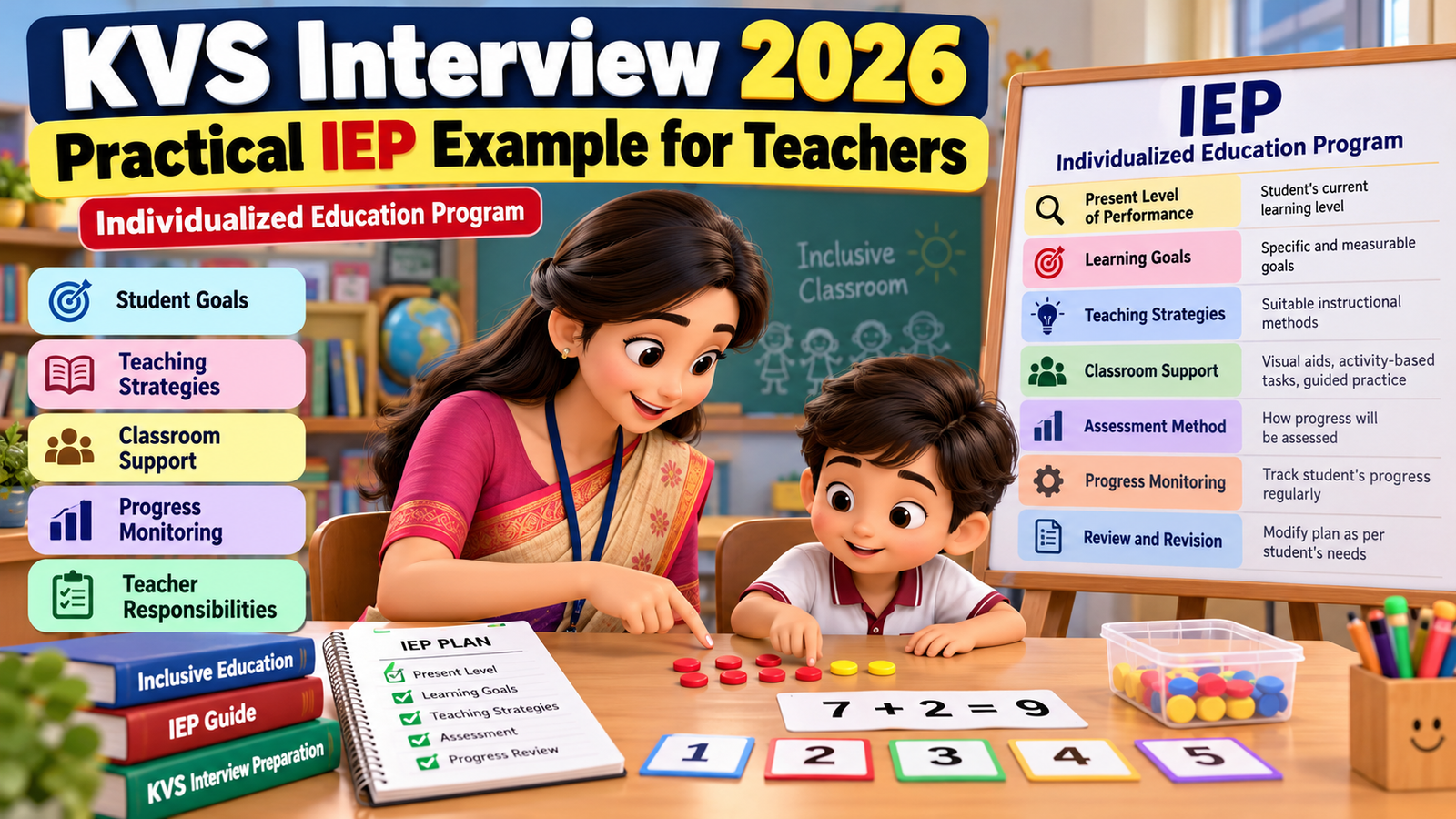
A practical IEP may include the following components, depending on the applicable educational framework and the student’s requirements:
- Present Level of Performance: Student abhi kya jaanta hai aur kya kar sakta hai.
- Individual Learning Needs: Student ko kis area mein additional educational support ki zaroorat hai.
- Measurable Learning Goals: Student ke liye clear aur assessable educational targets.
- Teaching Strategies: Learning improve karne ke liye suitable instructional methods.
- Classroom Support: Visual aids, learning materials, additional practice aur other appropriate accommodations.
- Assessment Methods: Student ki learning aur progress assess karne ke tareeke.
- Progress Monitoring: Defined goals ke against student ki progress regularly track karna.
- Review and Revision: Student ki progress aur changing needs ke according plan ko review karna.
Important: IEP ko student ki actual educational needs aur applicable guidelines ke according prepare aur review kiya jana chahiye. Har student ke liye same goals ya teaching strategies appropriate nahi hoti.
Practical IEP Example for Teachers: A Primary School Student
KVS PRT Interview 2026 mein practical example dene ke liye aap primary classroom ka ek simple Maths situation use kar sakte hain.
Maan lijiye, ek primary-level student ko number recognition aur basic addition mein difficulty aa rahi hai.
Classroom observation aur assessment ke through teacher identify karta hai ki the student:
- Numbers 1–20 mein se kuch numbers independently identify kar sakta hai.
- Objects ko count kar sakta hai.
- Written numerals identify karte waqt mistakes karta hai.
- Concrete objects ki help se simple addition attempt karta hai.
- Independent calculation ke liye additional guided practice ki zaroorat rakhta hai.
In observations ke basis par teacher suitable learning goals aur support strategies plan kar sakta hai.
1. Present Level of Performance
Current Performance: Student concrete objects ki help se basic addition attempt karta hai, lekin written number recognition aur independent calculation mein additional support ki zaroorat hai.
Is information se teacher ko student ki existing abilities aur areas requiring support samajhne mein help milti hai.
2. Individual Learning Goal
Learning Goal: Student ko number recognition aur basic addition mein gradually greater independence develop karne mein support karna.
Goal ko student ki baseline assessment ke according specific aur measurable banana chahiye.
For example, agar baseline assessment show karti hai ki student 10 mein se 4 selected numerals independently identify kar sakta hai, toh teacher appropriate review period ke liye ek measurable target establish kar sakta hai, such as identifying at least 8 out of 10 selected numerals independently.
Yeh sirf illustrative example hai. Actual target student ki abilities, educational needs aur assessment findings ke according decide kiya jana chahiye.
3. Teaching Strategies and Classroom Support
Teacher student ki learning needs ke according different teaching strategies use kar sakta hai, such as:
- Number Cards: Written numerals ko identify aur recognize karne ke liye.
- Counting Counters: Addition ko concrete objects ke through demonstrate karne ke liye.
- Number Line: Numbers ke sequence aur addition process ko understand karne ke liye.
- Visual Aids: Concepts ko visually represent karne ke liye.
- Guided Practice: Teacher ki assistance ke saath step-by-step practice karne ke liye.
- Short Activity-Based Tasks: Learning ko manageable aur engaging banane ke liye.
- Individual or Small-Group Support: Student ki requirements ke according additional practice provide karne ke liye.
Teacher ko student ki response ke according instructional support adjust karna chahiye.
4. Practical Classroom Activity for an IEP Goal
Topic: Basic Addition
Teacher student ko 7 counters deta hai aur poochta hai:
“If I add 2 more counters, how many counters do we have?”
Student counters ko count karta hai. Teacher zaroorat ke according verbal prompts ya visual support provide karta hai.
Phir teacher board par equation likhta hai:
7 + 2 = 9
Student counters ki help se answer verify karta hai. Next step mein teacher number cards ya pictures use karke similar questions practice karwa sakta hai.
Jaise-jaise student concept understand karta hai, teacher gradually unnecessary prompts reduce kar sakta hai aur independent responses ko encourage kar sakta hai.
This practical IEP example for teachers demonstrates how classroom instruction can be adapted according to a student’s learning needs.
How to Write Measurable IEP Goals
KVS PRT Interview 2026 aur KVS Special Educator Interview mein measurable learning goals ko explain karna useful ho sakta hai.
IEP goal aisa hona chahiye jisse teacher understand kar sake ki student ko kya learn karna hai aur progress ko kaise measure kiya jayega.
Example of a Weak IEP Goal
“The student will improve in Maths.”
Yeh goal broad hai. Ismein specific skill, expected performance aur assessment criteria clearly defined nahi hain.
Example of a Better IEP Goal
“The student will identify selected numerals from 1–20 independently, meeting the agreed assessment criterion during regular classroom assessments.”
Is goal mein target skill aur independence par focus hai. Exact accuracy level, assessment frequency aur review period student ki baseline assessment aur educational needs ke according define kiye jane chahiye.
A useful approach is to define:
- Skill: Student ko kya learn karna hai?
- Baseline: Student currently kya kar sakta hai?
- Target: Expected improvement kya hai?
- Measurement: Progress kaise assess hogi?
- Review: Goal aur support ko kab review kiya jayega?
Is approach se teacher student ki progress ko more systematically monitor kar sakta hai.
What Is the Role of a Teacher in IEP Preparation?
KVS interview panel teacher ki practical understanding aur inclusive classroom mein decision-making approach ko assess kar sakta hai.
Teacher ki responsibilities mein, applicable framework aur school procedures ke according, following activities include ho sakti hain:
- Observe the Student: Student ki academic performance, classroom participation aur learning needs ko observe karna.
- Identify Strengths and Difficulties: Student kya achha kar raha hai aur kis area mein support chahiye, yeh identify karna.
- Document Relevant Information: Classroom observations aur assessment findings ko appropriately record karna.
- Plan Learning Goals: Student ki present performance ke according suitable educational goals plan karna.
- Select Teaching Strategies: Appropriate teaching methods, learning materials aur classroom support choose karna.
- Promote Classroom Participation: Student ko meaningful learning activities mein participate karne ke opportunities dena.
- Monitor Progress: Defined assessment criteria ke according student ki progress track karna.
- Coordinate with Parents and Professionals: Where appropriate, parents, special educators aur other relevant professionals ke saath coordinate karna.
- Review Teaching Strategies: Agar expected progress nahi ho rahi hai, toh instructional approach aur required support ko review karna.
A teacher should focus on the student’s individual strengths, educational needs and appropriate support rather than labelling the student as weak.
KVS Interview 2026: Practical IEP Questions and Answers
IEP-related interview questions ki preparation karte waqt definition ke saath practical classroom applications bhi understand karein.
Q1. What Is an IEP?
Answer:
“IEP stands for Individualized Education Program. It is a structured educational plan developed according to an eligible student’s individual learning needs, educational goals, required support and progress. It helps teachers plan appropriate instruction and monitor learning outcomes.”
Q2. Why Is IEP Important in Inclusive Education?
Answer:
“IEP is important because it helps teachers identify individual educational needs, establish appropriate learning goals and plan suitable teaching strategies. It also supports progress monitoring and the review of educational support according to the student’s needs.”
Q3. How Will You Prepare an IEP for a Student?
Answer:
“First, I will assess the student’s present level of performance and identify their strengths and learning needs. Then, appropriate measurable goals, teaching strategies, classroom support and assessment methods will be planned in accordance with the applicable framework. I will monitor progress regularly and review the plan whenever required.”
Q4. What Information Should a Teacher Observe Before Planning an IEP?
Answer:
“Before planning an IEP, I will observe the student’s current academic performance, strengths, classroom participation, communication, learning difficulties and support requirements. I will also consider relevant assessment information and coordinate with parents and appropriate professionals wherever necessary.”
Q5. How Will You Know Whether an IEP Goal Is Working?
Answer:
“I will assess the student’s progress against the defined learning goals and assessment criteria. I will maintain appropriate progress records and observe whether the student is developing the targeted skills. If the expected progress is not observed, I will review the teaching strategies and coordinate with the relevant team to determine appropriate next steps.”
Q6. What Will You Do If a Student Is Not Achieving the IEP Goal?
Answer:
“If a student is not achieving the expected goal, I will review the student’s progress records, identify possible learning barriers and check whether the teaching strategies and support are appropriate. I will make suitable instructional adjustments and consult the relevant professionals and parents, where appropriate, to support the student’s progress.”
How to Apply an IEP Approach in KVS PRT Demo Teaching
Agar aap KVS PRT Maths demo teaching de rahe hain, toh inclusive classroom ke context mein IEP-based instructional adaptation ka simple example present kar sakte hain.
Demo Teaching Topic: Addition
Step 1: Introduce the Concept
Teacher counters ya objects ki help se addition introduce karta hai.
Step 2: Provide Appropriate Support
Jis student ko difficulty ho rahi hai, uske liye number cards, visual aids ya concrete objects use kiye ja sakte hain.
Step 3: Encourage Student Participation
Teacher student ko objects count karne aur answer identify karne ka opportunity deta hai.
Step 4: Assess Understanding
Teacher short questions aur guided practice ke through check karta hai ki student concept understand kar raha hai ya nahi.
Step 5: Monitor and Adjust
Teacher student ki response observe karta hai, feedback deta hai aur required support adjust karta hai. Progress ko relevant learning goals ke against monitor kiya jata hai.
Is example se aap demonstrate kar sakte hain ki inclusive teaching mein student ki learning needs ke according instruction adapt karna, participation encourage karna aur progress monitor karna important hai.
Common Mistakes to Avoid While Preparing an IEP
IEP prepare karte waqt teachers ko kuch common mistakes avoid karni chahiye:
- Ignoring Baseline Assessment: Student ki current learning level ko samjhe bina goals decide karna.
- Writing Vague Goals: “Student will improve” jaise broad goals use karna.
- Ignoring Student Strengths: Sirf difficulties par focus karna.
- Using the Same Strategy for Every Student: Individual learning needs ko consider na karna.
- Not Defining Assessment Criteria: Progress measure karne ka clear method establish na karna.
- Ignoring Progress Monitoring: Student ki learning ko regularly review na karna.
- Not Reviewing Support: Expected progress na hone par teaching approach ko reconsider na karna.
- Ignoring Collaboration: Applicable school procedures ke according parents aur relevant professionals ke input ko consider na karna.
A well-planned IEP should remain focused on the student’s educational needs, meaningful goals and appropriate support.
KVS Interview 2026: IEP Preparation Checklist for Teachers
KVS PRT Interview 2026 aur KVS Special Educator Interview 2026 ki preparation ke liye following checklist use karein:
- IEP Full Form: Individualized Education Program.
- IEP Purpose: Individual learning needs aur educational goals ko address karna.
- Present Level of Performance: Student ki current abilities aur learning needs explain karna.
- Measurable Goals: Specific learning targets ke examples prepare karna.
- Teaching Strategies: Visual aids, counters, number cards aur guided practice ke examples samajhna.
- Classroom Support: Individual needs ke according instructional adaptation explain karna.
- Progress Monitoring: Student ki learning assess karne ka method batana.
- Review and Revision: Expected progress na hone par appropriate next steps explain karna.
- Practical Example: Primary-level student ke liye ek simple IEP-based classroom example practice karna.
Interview Tip: IEP ki definition ko ratne ke bajay uska purpose, practical application aur student progress monitor karne ka process samjhein. Panel ke follow-up questions ke liye apne answer ko real classroom examples ke through explain karne ki practice karein.
KVS PRT Interview Preparation 2026 at TN Academy®
Agar aap KVS PRT Interview 2026 ki preparation kar rahe hain, toh IEP ke saath inclusive classroom situations, differentiated instruction, classroom management, demo teaching aur mock interview questions ki practical preparation bhi karein.
TN Academy® — Govt Job Coaching Institute, Bahadurgarh
Trusted Education Brand | Education Legacy Since 14 March 2013
KVS PRT Interview Preparation 2026 — 4th Fresh Batch
20-Day Intensive Interview Preparation Module
KVS Special Educator PRT + TGT Interview Preparation 2026 — 5th Fresh Batch
Batch details aur personal counselling ke liye contact karein.
Call / WhatsApp: 9729299034
Tarun Dhankar Sir
Founder • Director • CEO — TN Academy®
Career Mentor | Interview Panelist | Mathematician
TN Academy® — Trusted Education Brand with a Legacy Since 14 March 2013.
TN Academy® interview preparation and training provide karta hai. Selection official recruitment process aur candidate performance par depend karta hai.