DSSSB TGT English: Syllabus, Important Topics and Practice Questions
Preparing for DSSSB TGT English requires a clear understanding of the applicable examination syllabus, strong English language skills and consistent practice. Candidates should focus on grammar, vocabulary, reading comprehension and other subject-specific areas mentioned in the relevant recruitment notification.
A structured preparation strategy can help candidates improve accuracy, strengthen conceptual understanding and identify topics that require additional revision. Regular practice questions and mock tests can also help evaluate preparation progress.
Important: The exact syllabus, examination pattern and selection process may vary by recruitment notification. Always check the latest applicable notification on the official Delhi Subordinate Services Selection Board (DSSSB) website before finalising your study plan.
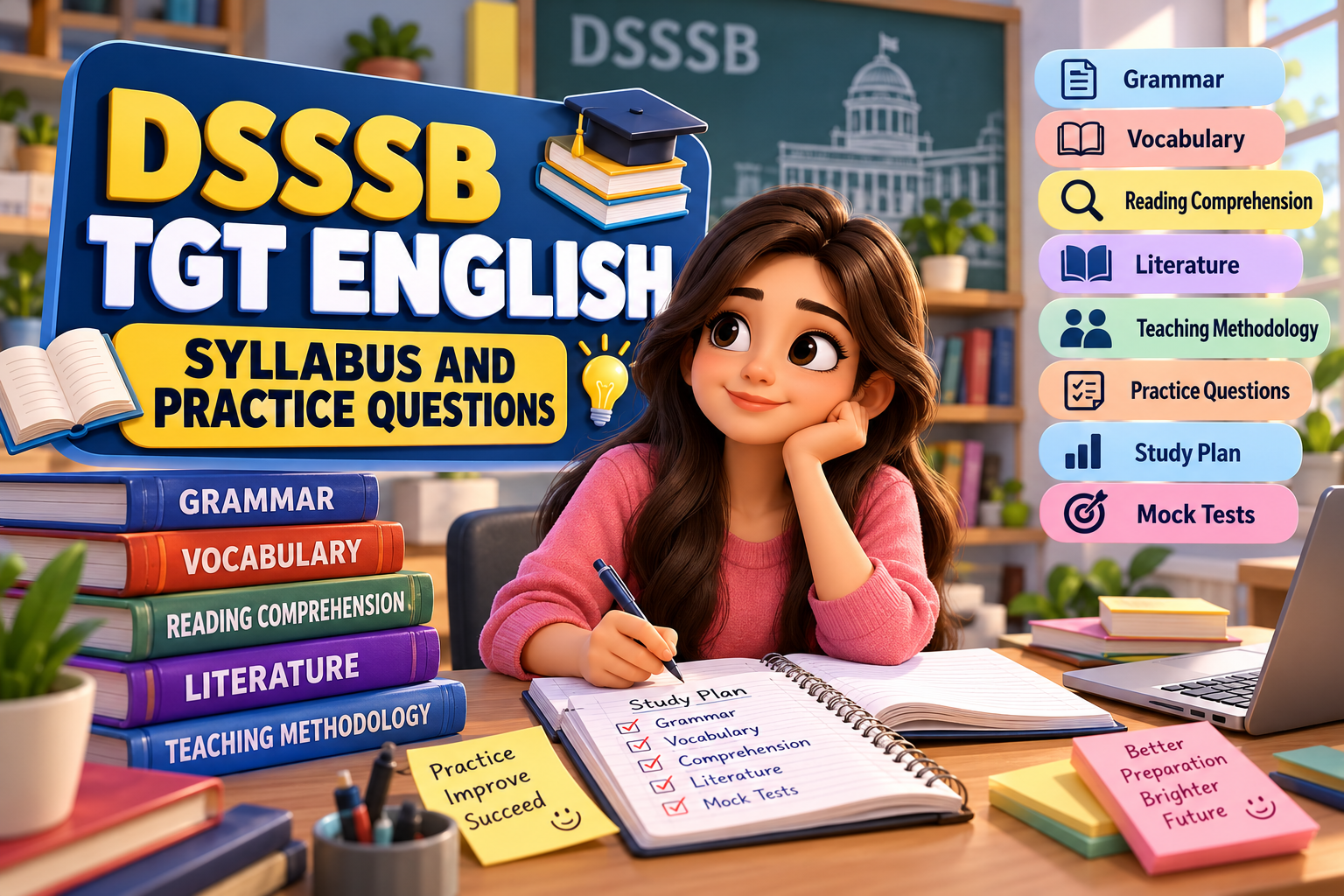
DSSSB TGT English Syllabus: Important Topics to Prepare
Candidates should organise their preparation according to the official syllabus. The following areas can help structure revision wherever they are included in the applicable examination scheme.
English Grammar
English grammar practice is essential for improving sentence accuracy and understanding grammatical structures. Revise the rules, examples and question types relevant to your syllabus.
Important grammar topics may include:
- Parts of speech
- Tenses
- Subject-verb agreement
- Articles and determiners
- Prepositions
- Active and passive voice
- Direct and indirect speech
- Sentence correction
- Error identification
- Sentence structure and usage
Preparation Tip: Practise grammar through complete sentences rather than memorising rules in isolation. Review incorrect answers and understand why a particular option is grammatically correct.
Vocabulary: Synonyms, Antonyms and Word Usage
Vocabulary preparation helps candidates understand written passages and select appropriate words in context.
Focus on the following areas wherever relevant:
- Synonyms and antonyms
- Idioms and phrases
- One-word substitutions
- Commonly confused words
- Contextual vocabulary
- Word meanings and usage
Preparation Tip: Maintain a vocabulary notebook with new words, their meanings, synonyms, antonyms and example sentences. Revise these words regularly to improve retention.
Reading Comprehension
Reading comprehension tests your ability to understand written information, identify key ideas and interpret meaning from context.
Practise questions based on:
- Main idea and central theme
- Supporting details
- Inference and conclusion
- Author’s tone and purpose
- Meaning of words in context
- Fact-based and interpretative questions
Preparation Tip: Read the passage carefully, understand what each question asks and identify supporting evidence before selecting your answer. Timed practice can help improve reading speed and accuracy.
English Literature
If literature is included in the applicable DSSSB TGT English syllabus, prepare the prescribed literary works and concepts systematically.
Depending on the notified syllabus, relevant areas may include:
- Prescribed authors and literary works
- Literary periods and movements
- Poetry, drama, fiction and prose
- Themes, characters and major events
- Figures of speech and literary devices
- Literary terminology and criticism
Preparation Tip: Use the official syllabus to identify the required authors, texts and literary concepts. Avoid spending excessive time on topics that are not part of the prescribed syllabus.
English Language Teaching and Pedagogy
If teaching methodology or English pedagogy is prescribed, revise the relevant concepts alongside subject knowledge.
Possible areas include:
- Language acquisition and learning
- Development of communication skills
- Teaching-learning materials
- Lesson planning
- Classroom activities
- Assessment and evaluation
- Learner-centred teaching methods
- Identification of common language-learning difficulties
Preparation Tip: Connect theoretical concepts with practical classroom situations. Practise application-based questions wherever they are relevant to the examination.
DSSSB TGT English Practice Questions with Answers
Practising TGT English questions helps reinforce concepts and identify common errors. Attempt the following questions before checking the answers.
Question 1: Subject-Verb Agreement
Choose the grammatically correct sentence.
A. She go to school daily.
B. She goes to school daily.
C. She going to school daily.
D. She gone to school daily.
Correct Answer: B. She goes to school daily.
Explanation: In the simple present tense, a singular third-person subject such as “she” takes the verb form “goes”.
Question 2: Synonym
Choose the closest synonym of “Abundant”.
A. Scarce
B. Plentiful
C. Weak
D. Empty
Correct Answer: B. Plentiful.
Explanation: “Abundant” means available in large quantities. “Plentiful” has a similar meaning.
Question 3: Antonym
Choose the antonym of “Ancient”.
A. Old
B. Historic
C. Modern
D. Traditional
Correct Answer: C. Modern.
Explanation: “Ancient” refers to something belonging to the distant past, whereas “modern” refers to the present or recent times.
Question 4: Tenses
Choose the correct option to complete the sentence:
“By the time we arrived, the train _____.”
A. leaves
B. has leave
C. had left
D. leaving
Correct Answer: C. had left.
Explanation: The past perfect tense, “had left”, indicates that the train’s departure occurred before another past event.
Question 5: Active and Passive Voice
Change the following sentence into passive voice:
“The teacher explained the lesson.”
Correct Answer: The lesson was explained by the teacher.
Explanation: The object “the lesson” becomes the subject of the passive sentence. The simple past verb “explained” changes to “was explained”.
Question 6: Reading Comprehension
Read the passage:
“Regular reading improves vocabulary and helps readers understand different writing styles.”
Question: What are two benefits of regular reading?
Correct Answer: Improved vocabulary and a better understanding of different writing styles.
Explanation: Both benefits are stated directly in the passage.
Practice Recommendation: After attempting these questions, revise the concepts behind any incorrect answers. These questions are for practice and should not be treated as verified previous-year DSSSB examination questions.
Four-Week DSSSB TGT English Study Plan
A four-week study plan can help you organise revision and practise consistently. Adjust the schedule according to the official syllabus, your preparation level and the time available before the examination.
Week 1: Grammar and Sentence Correction
Focus Areas:
- Revise important grammar rules.
- Practise subject-verb agreement and tenses.
- Solve sentence correction and error identification questions.
- Review incorrect answers and note recurring mistakes.
Weekly Target: Build a strong foundation in the grammar topics included in your syllabus.
Week 2: Vocabulary and Reading Comprehension
Focus Areas:
- Revise synonyms, antonyms and idioms.
- Learn new words through contextual reading.
- Practise comprehension passages.
- Work on identifying the main idea, inference and tone.
Weekly Target: Improve vocabulary retention and comprehension accuracy.
Week 3: Literature and Pedagogy
Focus Areas:
- Revise prescribed literary texts and authors, where applicable.
- Study literary devices and important concepts.
- Revise English pedagogy if it is included in the syllabus.
- Practise topic-wise questions.
Weekly Target: Strengthen subject-specific knowledge according to the notified syllabus.
Week 4: Mock Tests and Final Revision
Focus Areas:
- Attempt mixed practice sets.
- Take timed mock tests based on the applicable examination pattern.
- Analyse incorrect and unanswered questions.
- Revise weak topics and important notes.
- Review progress and adjust the final revision schedule.
Weekly Target: Improve accuracy, time management and familiarity with the relevant question format.
Note: This is a suggested preparation framework, not an official DSSSB timetable. The time allocated to each topic should reflect its relevance in the applicable syllabus.
How to Improve Accuracy in DSSSB TGT English
Follow these practical strategies to make your DSSSB English preparation more effective:
- Study One Grammar Topic at a Time: Understand the rule before attempting advanced questions.
- Practise with Example Sentences: Apply grammatical concepts to different sentence structures.
- Read English Regularly: Use suitable articles, passages and prescribed reading materials to strengthen comprehension.
- Maintain an Error Notebook: Record incorrect answers, the correct rule and the reason for the mistake.
- Practise Timed Comprehension Sets: Develop the ability to locate relevant information efficiently.
- Revise Vocabulary Systematically: Use spaced revision instead of learning large lists only once.
- Attempt Syllabus-Based Mock Tests: Choose practice material that reflects the applicable examination pattern.
- Analyse Your Performance: Identify recurring weaknesses and give them additional revision time.
Consistency, syllabus-based preparation and regular error analysis can help you make better use of your study time.
Frequently Asked Questions About DSSSB TGT English
Q1. What should I study for DSSSB TGT English?
Prepare the topics specified in the applicable official recruitment syllabus. Grammar, vocabulary, reading comprehension, literature and English pedagogy may be relevant depending on the notified examination requirements.
Q2. How can I improve my English grammar quickly?
Learn one grammatical rule at a time, study correct and incorrect examples, solve practice questions and review every mistake. Regular revision helps improve accuracy.
Q3. Is English literature important for DSSSB TGT English?
Its importance depends on the applicable syllabus. Check the official notification and prescribed topics before deciding how much time to allocate to authors, literary works, periods and literary devices.
Q4. How can I practise for the DSSSB TGT English examination?
Use syllabus-based practice questions, topic-wise exercises and mock tests. Review your mistakes after each practice session and focus on concepts that need improvement.
Q5. Where can I check official DSSSB recruitment details?
Visit the official website of the Delhi Subordinate Services Selection Board:
Official Website: https://dsssb.delhi.gov.in/
Check the relevant recruitment advertisement and official syllabus for the latest details about eligibility, examination scheme and selection procedure.
DSSSB TGT English Preparation at TN Academy®
TN Academy® is a government job coaching institute in Bahadurgarh, Delhi NCR. Candidates preparing for teaching recruitment can enquire about relevant TGT English preparation, grammar practice, mock tests and available coaching batches.
Before enrolling, confirm the availability of the specific course, faculty details, batch timings, fees and demo-class options.
Call/WhatsApp: 9729299034
Website: https://tnacademy.in/
Campus Address: 3rd Floor, Radha Ganga Arcade, Opp. Jhajjar Mod, Delhi–Rohtak Road, Metro Pillar 848, Bahadurgarh, Haryana 124507.
Interested in TGT English Preparation? Contact TN Academy® to enquire about current course availability and suitable preparation options.
Conclusion
Effective DSSSB TGT English preparation begins with understanding the official syllabus and following a structured revision plan. Focus on relevant grammar concepts, vocabulary, comprehension and any prescribed literature or pedagogy topics.
Combine regular practice questions with mock tests and detailed error analysis to identify weaknesses and improve accuracy. Most importantly, verify the latest official recruitment notification before finalising your preparation strategy.
Disclaimer: The topics discussed in this article are general preparation guidance and are not a substitute for the applicable official DSSSB syllabus, eligibility requirements or selection-process details. Verify all examination-related information through the official DSSSB website.