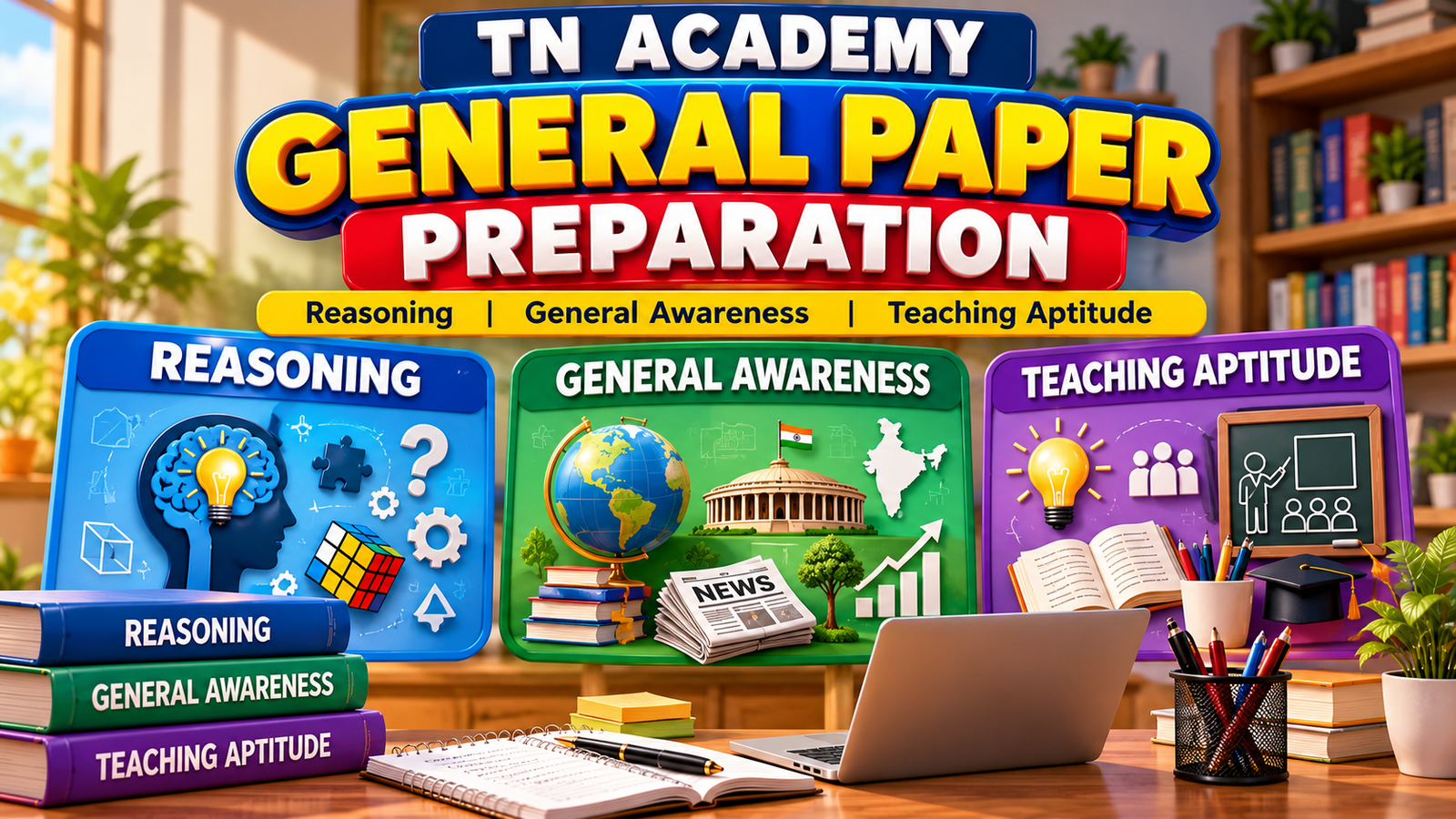
General Paper Preparation: Reasoning, General Awareness and Teaching Aptitude
Preparing for a General Paper requires a clear understanding of the examination syllabus, regular practice and an effective revision strategy. Many competitive examinations include sections such as reasoning, general awareness, teaching aptitude and other subject-specific areas to evaluate a candidate’s knowledge, analytical ability and problem-solving skills.
However, the subjects, question distribution, weightage and marking scheme may differ from one examination to another. Therefore, candidates should always begin their preparation by checking the latest official notification and understanding the requirements of their target examination.
A well-planned General Paper preparation strategy can help candidates manage different subjects, improve accuracy, strengthen conceptual understanding and make better use of their study time.
In this guide, you will learn how to prepare for reasoning, general awareness and teaching aptitude, follow a practical daily study plan and improve your performance through regular practice and revision.
1. Understand the General Paper Syllabus Before Starting
The first step in General Paper preparation is to understand the prescribed syllabus of your target examination. Avoid following a common preparation strategy without checking whether the topics are actually included in your examination.
Different recruitment examinations may have different General Paper structures. Some focus more on reasoning and general knowledge, while others may include teaching aptitude, educational concepts or additional subject areas.
Start your preparation with these steps:
- Download and review the latest official examination notification.
- Identify all prescribed subjects and topics.
- Check the examination pattern and marking scheme.
- Review previous-year question papers, where available.
- Divide topics according to their difficulty level and preparation status.
Create a topic-wise checklist using three categories:
- Strong Topics: Concepts you already understand and can solve accurately.
- Topics Requiring Practice: Areas where you understand the basics but need more question-solving practice.
- Weak Topics: Concepts that require detailed study and repeated revision.
This approach helps you prioritise important areas and avoid spending time on irrelevant study material.
2. Reasoning Preparation Strategy: Improve Logical Thinking and Accuracy
Reasoning is an important section in several competitive examinations. It evaluates a candidate’s ability to identify patterns, understand relationships, analyse information and solve problems logically.
The best reasoning preparation strategy is to understand the basic concepts first and gradually increase the difficulty level of practice questions.
Important Reasoning Topics
Depending on your examination syllabus, prepare the following topics:
- Analogy and Classification
- Number and Alphabet Series
- Coding and Decoding
- Blood Relations
- Direction Sense
- Ranking and Order
- Syllogism
- Logical Arrangements
- Statement and Conclusion
- Statement-Based Reasoning
- Mathematical and Logical Operations
How to Prepare Reasoning Effectively
Step 1: Understand the Basic Concepts
Start by learning the rules, patterns and methods used to solve different reasoning questions. Understand the logic behind each question type instead of memorising answers.
Step 2: Practise Topic-Wise Questions
Select one topic at a time and solve basic questions. This helps you understand the different question patterns and common mistakes.
Step 3: Move Towards Mixed Practice
Once you understand individual topics, attempt mixed reasoning questions. This will improve your ability to identify the correct approach without knowing the question type in advance.
Step 4: Introduce Time-Based Practice
Start solving questions within a fixed time after achieving reasonable accuracy. Gradually work on improving your speed without compromising correctness.
Step 5: Analyse Incorrect Answers
Maintain a separate record of incorrect and time-consuming questions. Identify whether the mistake occurred due to a conceptual gap, incorrect calculation or misunderstanding of the question.
Reasoning Preparation Tips
- Practise reasoning questions regularly.
- Learn shortcuts only after understanding the basic method.
- Solve previous-year questions relevant to your examination.
- Focus on accuracy before increasing speed.
- Revise difficult question patterns every week.
Consistent practice and error analysis are more useful than simply solving a large number of questions without reviewing them.
3. General Awareness Preparation Strategy
General Awareness preparation requires regular learning, factual understanding and repeated revision. Depending on the examination, this section may include static general knowledge, current affairs and subject-specific awareness.
Candidates should first identify the exact General Awareness topics prescribed in their examination syllabus.
Important General Awareness Topics
Where applicable, candidates can prepare the following areas:
Indian History
- Ancient Indian History
- Medieval Indian History
- Modern Indian History
- Indian National Movement
Indian Geography
- Physical Geography
- Indian States and Capitals
- Rivers and Mountain Ranges
- Climate and Natural Resources
Indian Polity
- Indian Constitution
- Fundamental Rights and Duties
- Parliament and Government
- Constitutional Bodies
Indian Economy
- Basic Economic Concepts
- Banking and Financial Awareness
- Budget and Economic Developments
- Government Economic Initiatives
General Science
- Basic Physics
- Basic Chemistry
- Biology
- Everyday Science
Current Affairs
- National and International Events
- Important Government Schemes
- Awards and Recognitions
- Sports and Important Appointments
- Major Developments relevant to the examination
How to Improve General Awareness Preparation
1. Prepare Short Notes
Create concise notes for important facts, dates, events and concepts. Organise them subject-wise so that revision becomes easier.
2. Follow Reliable Sources
Use standard study material and official government websites for information about government schemes, policies and announcements. Always verify examination-related information through the relevant recruiting authority.
3. Revise Regularly
Do not depend only on reading. After completing a topic, close your notes and try to recall the important information. Check your understanding against the original material.
4. Practise General Awareness Questions
Attempt topic-wise quizzes and examination-oriented practice questions. Analyse incorrect answers and revise the related facts.
5. Avoid Too Many Study Sources
Using too many books, websites and current affairs platforms can create unnecessary information overload. Select a manageable set of reliable resources and follow them consistently.
4. Teaching Aptitude Preparation: Important Concepts and Practice Questions
Teaching aptitude is relevant to examinations where the prescribed syllabus includes teaching-related knowledge, educational understanding or classroom-based situations.
This section may assess a candidate’s understanding of teaching methods, learning processes, student development, classroom management and educational assessment.
Important Teaching Aptitude Topics
Prepare the following concepts wherever they are included in your examination syllabus:
- Learner-Centred Teaching
- Teaching Methods and Approaches
- Lesson Planning
- Learning Objectives
- Classroom Management
- Inclusive Education
- Formative and Summative Assessment
- Teaching-Learning Materials
- Feedback and Remedial Teaching
- Student Participation
- Individual Differences Among Learners
- Ethical and Professional Responsibilities of Teachers
Teaching Aptitude Preparation Strategy
Understand the Teaching-Learning Process: Learn how teachers facilitate learning, communicate concepts and encourage student participation.
Focus on Classroom-Based Situations: Practise questions involving classroom management, student difficulties, learning gaps and appropriate teaching responses.
Study Assessment Methods: Understand the purpose and differences between formative and summative assessment.
Revise Educational Concepts: Prepare important definitions, principles and teaching approaches according to the prescribed syllabus.
Teaching Aptitude Practice Questions
Question 1: What is the main purpose of formative assessment?
A. To assign a final grade to students
B. To monitor learning during instruction
C. To rank students according to marks
D. To conduct only the final examination
Correct Answer: B. To monitor learning during instruction
Explanation: Formative assessment helps teachers identify students’ learning difficulties, provide timely feedback and improve the teaching-learning process.
Question 2: What should a teacher do when several students struggle to understand the same concept?
A. Move to the next topic immediately
B. Ignore the students’ difficulties
C. Explain the concept using an alternative teaching method
D. Give only additional homework
Correct Answer: C. Explain the concept using an alternative teaching method
Explanation: A teacher should identify the learning gap, use an appropriate explanation or teaching resource, provide guided practice and check whether students have understood the concept.
Note: These are illustrative practice questions and are not verified previous-year examination questions.
5. General Paper Study Plan: Daily Preparation Timetable
A structured timetable helps candidates divide their preparation time between different subjects. Instead of studying one subject for several hours continuously, use shorter and focused study sessions.
The following General Paper study plan can be used as a starting point and modified according to your examination syllabus and available preparation time.
| Subject / Activity | Suggested Duration | Preparation Activity |
|---|---|---|
| Reasoning | 45 Minutes | Learn concepts and solve questions |
| General Awareness | 45 Minutes | Study facts and revise notes |
| Teaching Aptitude | 45 Minutes | Understand concepts and practise questions |
| Mixed Practice | 30 Minutes | Attempt timed practice sets |
| Error Analysis | 15 Minutes | Review mistakes and plan revision |
Total Suggested Study Time: 3 Hours
How to Adjust Your Study Timetable
- If reasoning is your weak area, allocate additional time to problem-solving.
- If General Awareness requires more attention, increase revision sessions.
- If your examination does not include teaching aptitude, replace that session with another prescribed subject.
- If you have limited preparation time, shorten the sessions but maintain daily consistency.
The purpose of a timetable is to improve consistency and coverage, not to follow fixed timings without considering individual preparation needs.
6. How to Improve General Paper Mock Test Performance
Mock tests and practice papers help candidates understand their preparation level and identify areas that need improvement.
However, attempting multiple mock tests without analysing the results may not provide meaningful improvement.
After every practice test, classify your mistakes into four categories:
1. Knowledge Gap
You were unable to answer because you did not know the required fact or concept.
Solution: Revisit the topic and prepare short revision notes.
2. Conceptual Error
You understood the question incorrectly or applied the wrong method.
Solution: Study the basic concept again and solve similar questions.
3. Careless Mistake
You selected an incorrect answer because you misread the question, overlooked a detail or made an avoidable calculation error.
Solution: Practise careful question reading and check your answers wherever time permits.
4. Time Management Issue
You spent too much time on a particular question and could not attempt other questions efficiently.
Solution: Practise timed question sets and learn to identify questions that require more time.
Maintain a Mistake Analysis Record
After each mock test, record:
- Subject and topic
- Total questions attempted
- Correct answers
- Incorrect answers
- Questions left unattempted
- Main reason for mistakes
- Topics requiring revision
Use this record to plan your next preparation session.
7. Weekly Revision Strategy for General Paper Preparation
Revision is essential for retaining information and improving performance. A weekly revision routine helps candidates revisit completed topics while maintaining progress in new areas.
Follow this sample seven-day revision schedule:
| Day | Preparation Focus |
|---|---|
| Day 1 | Learn new reasoning concepts and practise questions |
| Day 2 | Study General Awareness and revise previous notes |
| Day 3 | Prepare teaching aptitude concepts, if applicable |
| Day 4 | Attempt mixed reasoning and general awareness questions |
| Day 5 | Revise weak and difficult topics |
| Day 6 | Attempt a syllabus-aligned practice test |
| Day 7 | Analyse mistakes and prepare the next week’s study plan |
Effective Revision Techniques
- Use short notes for quick revision.
- Revisit difficult concepts at regular intervals.
- Practise questions from previously completed topics.
- Use active recall to test your understanding.
- Maintain a separate list of frequently repeated mistakes.
- Compare your preparation progress with the official syllabus.
A combination of regular study, practice and revision can make your General Paper preparation more organised and effective.
8. General Paper Preparation Guidance at TN Academy®
TN Academy® is a government job coaching institute located in Bahadurgarh, Haryana. Candidates preparing for competitive examinations can contact the institute to enquire about currently available coaching programmes and preparation guidance relevant to their target examination.
Before selecting a preparation programme, candidates should understand the examination requirements, syllabus coverage, available classes and practice support.
Contact TN Academy®
- Phone / WhatsApp: 9729299034
- Website: https://tnacademy.in/
- Address: 3rd Floor, Radha Ganga Arcade, Opp. Jhajjar Mod, Delhi–Rohtak Road, Metro Pillar 848, Bahadurgarh, Haryana 124507.
Frequently Asked Questions (FAQs)
1. How should I prepare for a General Paper?
Start by reviewing the official examination syllabus. Divide the subjects into smaller topics, understand the basic concepts, practise relevant questions and revise regularly. Use mock tests to evaluate your preparation.
2. How can I improve my reasoning speed and accuracy?
First, understand the basic concepts and practise topic-wise questions. Once your accuracy improves, start attempting timed practice sets. Analyse incorrect answers to identify patterns and improve your problem-solving approach.
3. What is the best way to prepare for General Awareness?
Follow reliable study sources, prepare concise subject-wise notes and revise regularly. Focus on static general knowledge and current affairs only to the extent required by your examination syllabus.
4. Is teaching aptitude included in every General Paper?
No. Teaching aptitude is not included in every competitive examination. The subjects and syllabus differ according to the recruiting authority and examination. Always check the official notification before starting preparation.
5. Should I attempt mock tests before completing the syllabus?
Yes. Topic-wise tests and short practice sets can be useful from the beginning of preparation. Full-length mock tests should follow the current examination pattern and should be analysed properly to identify areas requiring improvement.
6. How many hours should I study daily for General Paper preparation?
The required study time depends on your existing knowledge, examination difficulty and available preparation period. A focused three-hour daily study plan can be a useful starting point, but candidates should adjust their schedule according to individual requirements.
7. How can I remember General Awareness facts for a longer time?
Prepare concise notes, practise active recall, use topic-wise quizzes and revise information at regular intervals. Repeated revision is generally more effective than reading the same material without testing your memory.
Conclusion
Effective General Paper preparation requires more than simply reading books or solving practice questions. Candidates need a clear understanding of the official syllabus, a subject-wise study plan, regular practice and a consistent revision routine.
Focus on building logical thinking through reasoning, strengthening factual knowledge through General Awareness and understanding educational concepts through teaching aptitude wherever applicable.
Most importantly, analyse your mistakes, work on weak topics and evaluate your preparation through syllabus-aligned practice tests.
A structured approach, consistent effort and regular revision can help you prepare more confidently for your target competitive examination.
Important Note: The subjects, topics and sample questions discussed in this article are general preparation guidance. The actual syllabus, examination pattern, selection process and marking scheme may vary. Always refer to the latest official notification issued by the relevant examination authority.

You may also like
KVS PGT Subject Knowledge: How to Prepare and Revise Effectively