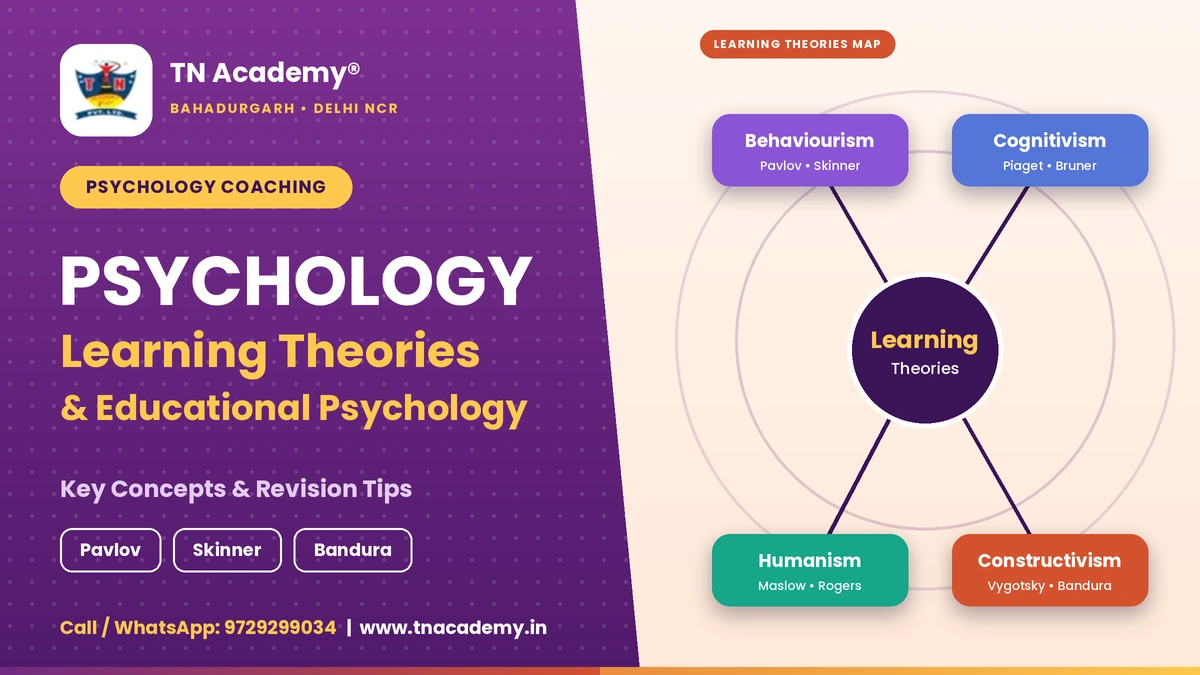
Psychology Coaching: Learning Theories and Educational Psychology | Practical Guide
Psychology Coaching: Why Educational Psychology Matters
Educational psychology helps teachers understand how learners think, develop knowledge, respond to feedback and interact in the classroom.
Candidates preparing for teaching recruitment examinations can use learning theories to understand educational concepts and solve theory-based and classroom-situation questions.
Students studying psychology can also benefit from connecting theoretical ideas with practical examples rather than relying entirely on memorisation.
What Is Educational Psychology?
Educational psychology studies psychological processes related to teaching and learning. These include cognition, motivation, memory, development, individual differences, assessment and classroom behaviour.
Teachers can use educational psychology to select appropriate teaching methods, recognise learning difficulties and create supportive classroom environments.
1. Piaget’s Cognitive Development Theory
Jean Piaget explained how children’s thinking develops through different stages. The four commonly identified stages are:
Sensorimotor → Preoperational → Concrete Operational → Formal Operational
- Sensorimotor: Birth to approximately 2 years.
- Preoperational: Approximately 2–7 years.
- Concrete operational: Approximately 7–11 years.
- Formal operational: Approximately 11 years onward.
Classroom Application
Teachers can use concrete objects, visual examples and hands-on activities to support learners who benefit from practical experiences.
Activities should be matched to the learner’s understanding rather than relying on age alone.
2. Vygotsky’s Sociocultural Theory
Lev Vygotsky highlighted the importance of social interaction and cultural context in learning.
Zone of Proximal Development
The Zone of Proximal Development, or ZPD, refers to the range of tasks a learner can accomplish with appropriate guidance but may not yet complete independently.
Classroom Application
Teachers can provide hints, worked examples, guided practice and structured peer collaboration. Support can gradually be reduced as learners become more independent.
3. Behaviourism
Behaviourism focuses on observable behaviour and the role of environmental conditions in learning.
Classical Conditioning
Ivan Pavlov is associated with classical conditioning, in which a previously neutral stimulus can become associated with a response through learning.
Operant Conditioning
B. F. Skinner is associated with operant conditioning, which examines how consequences influence the likelihood of behaviour.
Classroom Application
Clear expectations, consistent feedback and appropriate reinforcement can support positive learning habits. Teachers should use respectful, constructive approaches and avoid humiliating students.
4. Constructivism
Constructivism emphasises that learners actively build understanding by connecting new information with existing knowledge and experience.
Classroom Application
Teachers can use:
- Problem-solving tasks.
- Guided discovery.
- Discussion and questioning.
- Group activities.
- Experiments and real-life examples.
- Reflection on misconceptions.
The teacher’s role includes guiding learning, checking understanding and providing appropriate support.
5. Bandura’s Social Learning Theory
Albert Bandura highlighted learning through observing others and the role of modelling.
Students may learn behaviours, strategies and social responses by watching teachers, classmates and other people.
Classroom Application
Teachers can demonstrate problem-solving methods, respectful communication and classroom routines. Students can then practise the behaviour and receive feedback.
6. Motivation in Learning
Motivation influences students’ effort, persistence and engagement.
Intrinsic motivation: Engaging in an activity because of interest, enjoyment or personal satisfaction.
Extrinsic motivation: Engaging in an activity to obtain an external outcome or avoid a consequence.
Teachers can encourage motivation through achievable goals, constructive feedback, meaningful tasks and opportunities for students to recognise their progress.
7. Individual Differences and Inclusive Classrooms
Students differ in prior knowledge, interests, language, learning pace and support needs.
Effective teachers can respond by using multiple explanations, accessible resources, structured activities and suitable assessment methods.
Inclusive teaching focuses on meaningful participation and fair opportunities to learn.
Educational Psychology Practice Questions
Q1. Who is associated with the stages of cognitive development?
Answer
Jean Piaget.
Q2. Which psychologist is associated with the Zone of Proximal Development?
Answer
Lev Vygotsky.
Q3. Who is associated with classical conditioning?
Answer
Ivan Pavlov.
Q4. Who is associated with operant conditioning?
Answer
B. F. Skinner.
Q5. Which theory highlights learning by observing others?
Answer
Albert Bandura’s social learning theory.
Q6. What is intrinsic motivation?
Answer
Motivation arising from interest, enjoyment or personal satisfaction in an activity.
Q7. What is formative assessment used for?
Answer
Monitoring learning during instruction and providing feedback to improve understanding.
How to Study Learning Theories Effectively
- Learn each psychologist’s name and central concept.
- Prepare comparison tables for related theories.
- Connect every theory with a practical classroom example.
- Practise multiple-choice and scenario-based questions.
- Revise important terms through flashcards.
- Review incorrect answers and clarify misconceptions.
- Follow the syllabus relevant to your examination or psychology course.
Frequently Asked Questions
Q1. Why is educational psychology important for teachers?
Answer
It helps teachers understand learning, development, motivation, classroom behaviour and individual differences.
Q2. Which learning theories should teacher candidates study?
Answer
Depending on the syllabus, important areas may include Piaget’s cognitive development theory, Vygotsky’s sociocultural theory, behaviourism, constructivism and Bandura’s social learning theory.
Q3. How can I remember learning theories?
Answer
Connect each theory with its main concept, associated psychologist and a practical classroom example.
Q4. Is educational psychology useful for teacher recruitment examinations?
Answer
It can be useful when educational psychology and pedagogy are part of the relevant syllabus. Always verify the specific examination requirements.
Psychology and Teacher Exam Preparation at TN Academy®
TN Academy® is a government job coaching institute in Bahadurgarh, Delhi NCR. Candidates preparing for teacher recruitment examinations can contact the academy to enquire about relevant psychology, pedagogy and teaching examination preparation options.
TN Academy® — Govt Job Coaching Institute, Bahadurgarh
Trusted Education Brand | Education Legacy Since 14 March 2013
Psychology & Teacher Exam Preparation
Contact for current batch details, course availability, timings and fees.
📞 Call / WhatsApp: 9729299034
📍 3rd Floor, Radha Ganga Arcade, Opp. Jhajjar Mod, Delhi–Rohtak Road, Metro Pillar 848, Bahadurgarh, Haryana 124507.
Tarun Dhankar Sir — Founder • Director • CEO, TN Academy®
Career Mentor | Interview Panelist | Mathematician
Disclaimer: The topics discussed here are educational guidance. Refer to the official syllabus for the examination or course you intend to pursue.