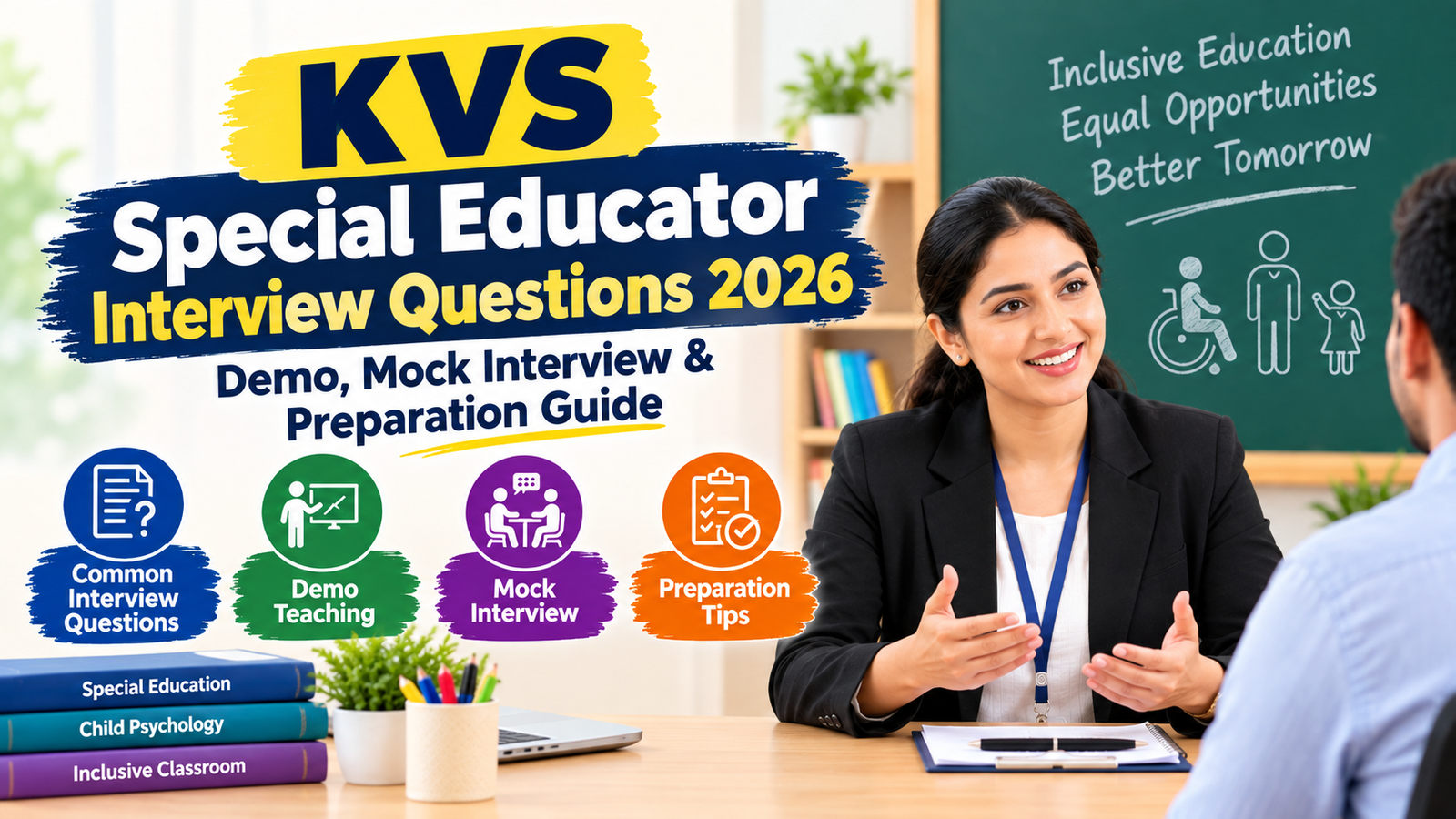
KVS Special Educator Interview Questions 2026: Demo, Mock Interview & Preparation Guide
If you are preparing for the KVS Special Educator Interview Questions 2026, your preparation should cover much more than memorising a list of interview questions.
A Special Educator interview requires preparation in areas such as special education, inclusive education, child development, classroom management, teaching strategies, communication, situational questions, demo teaching and mock interview practice. For a complete step-by-step approach, see the detailed KVS Special Educator Interview Preparation 2026 guide.
Candidates should verify their own recruitment-stage information and official instructions through the official Kendriya Vidyalaya Sangathan website, kvsangathan.nic.in, which publishes all notifications, admit cards, results and interview schedules for the Special Educator (PRT/TGT) recruitment drive.
This guide explains the major categories of KVS Special Educator Interview Questions 2026, along with demo teaching, classroom situations and mock interview preparation.
What Should You Prepare?
There is no reliable way to predict the exact questions a particular interview panel will ask. Preparation should be based on question categories. Important areas include:
- Self Introduction
- Biodata
- Special Education
- Inclusive Education
- Child Development
- Learning Needs
- Teaching Strategies
- Classroom Management
- Behavioural Situations
- Assessment
- Individualised Support
- Parent Communication
- Teacher Collaboration
- Demo Teaching
- Situational Questions
- Professional Communication
- Mock Interview
The objective should be to understand the concept and explain its practical classroom application.
1. KVS Special Educator Self Introduction Questions
The interview may begin with personal and professional questions. Prepare questions such as:
- Tell us about yourself.
- Tell us about your educational background.
- Why did you choose Special Education?
- Why do you want to become a teacher?
- Why do you want to join KVS?
- What are your strengths as an educator?
- What are your professional areas for improvement?
- What is your teaching philosophy?
- What motivates you as a teacher?
- How would you describe your approach to children with different learning needs?
How should you prepare? Do not memorise a long paragraph. Prepare a structured introduction:
Name → Qualification → Relevant Experience → Teaching Interest → Special Education Interest → Professional Goal
Keep the delivery natural and professional.
2. KVS Special Educator Biodata Questions
Anything mentioned in your biodata can become a discussion point. Prepare your educational qualifications, special education qualification, teaching experience, school experience, training, certifications, achievements, professional experience, hobbies and relevant skills.
For every important point in your biodata, prepare: What? → Why? → How? → Example
This will also help during cross-questioning.
3. Special Education Interview Questions
Prepare the fundamental concepts of Special Education.
What is Special Education? Prepare a clear conceptual explanation and connect it with the educational needs of learners.
What is the role of a Special Educator? Cover assessment, educational support, classroom participation, collaboration and appropriate intervention/support.
What is inclusive education? Explain inclusion from the perspective of meaningful participation and learning support in the classroom.
How can you support a child with different learning needs? Focus on understanding the learner, adapting teaching, providing appropriate support and monitoring progress.
How do you identify a child’s learning needs? Explain the importance of observation, assessment, classroom performance, communication and appropriate professional processes.
4. KVS Inclusive Education Interview Questions
Inclusive education should be prepared as a practical classroom concept. Possible preparation questions include:
- What is inclusive education, and why is it important?
- How can a classroom become more inclusive?
- How will you support different learners in one classroom?
- How can teaching be differentiated?
- How will you encourage peer participation?
- How can teaching-learning material be adapted?
- How will you assess students with different learning needs?
- How will you coordinate with the class teacher, and communicate with parents?
Practical Answer Framework: Identify Need → Adapt Teaching → Support Participation → Assess → Review
This keeps answers practical instead of purely theoretical.
5. KVS Special Educator Classroom Situation Questions
Situational questions require practical thinking. Prepare situations such as:
- A child is not participating in classroom activities. What will you do?
- A child repeatedly refuses to follow classroom instructions. How will you respond?
- A child becomes frustrated during a learning activity. What will you do?
- A learner requires repeated explanation of the same concept. How will you support the learner?
- A child has difficulty communicating with classmates. What classroom strategies can you use?
- A child is struggling to complete classroom work. How will you identify the problem and provide support?
- A parent is concerned about the child’s classroom progress. How will you communicate with the parent?
- The regular teacher and Special Educator need to coordinate support for a learner. How will you work together?
For situational questions, avoid giving a one-line answer. Use:
Situation → Observation → Learner Need → Strategy → Follow-up
6. KVS Special Educator Teaching Strategy Questions
Prepare questions around practical teaching:
- How will you teach a difficult concept, and how will you modify an activity?
- How will you support a slow learner?
- How will you use visual teaching aids?
- How will you divide a difficult task into smaller steps?
- How will you encourage participation and maintain engagement?
- How will you assess whether the learner understood?
- How will you provide individual support?
- How will you modify your teaching if the first strategy does not work?
The important point is to demonstrate flexible and learner-focused teaching.
7. KVS Special Educator Assessment Questions
Assessment should also be part of preparation. Possible questions include:
- How will you assess learning and identify areas requiring additional support?
- How will you monitor progress and provide feedback?
- How will you document progress?
- How will you communicate progress with parents and teachers?
Avoid treating assessment as only a final examination. Explain how observation, classroom performance, activities and appropriate assessment methods can contribute to understanding learner progress.
8. KVS Special Educator Demo Teaching 2026
Demo teaching requires practical preparation. Do not prepare only the topic — prepare the complete teaching process.
A useful structure is:
Introduction → Previous Knowledge → Learning Objective → Explanation → Activity → Interaction → Assessment → Feedback → Recap
Before the demo, prepare the topic, class/learner level, learning objective, previous knowledge, teaching method, teaching-learning material, activity, questions, board work, assessment and conclusion.
9. KVS Special Educator Demo Class: What Should You Demonstrate?
During a demo, the panel should be able to understand your teaching approach. Focus on:
- Clear Communication — use language appropriate to the learner
- Student Participation — do not make the demo only a teacher monologue
- Teaching Aids — use appropriate visual or practical material where relevant
- Step-by-Step Teaching — break complex learning into manageable steps
- Questioning — use simple questions first and gradually move towards deeper understanding
- Assessment — check whether the learner understood the concept
- Flexibility — if the learner does not respond as expected, demonstrate how you would modify your teaching approach
10. KVS Special Educator Mock Interview 2026
Mock interviews should reproduce the structure and pressure of an actual interview environment as far as practical. A structured mock can follow:
Entry → Greeting → Self Introduction → Biodata → Special Education → Inclusive Education → Pedagogy → Classroom Situations → Demo Discussion → Cross Questions → Feedback
After the mock, review content, answer structure, communication, eye contact, listening, body language, practical reasoning, confidence, cross-question handling and demo teaching.
The most important part is not the mock itself — it is the feedback and correction after the mock.
11. KVS Special Educator Cross-Questioning
Candidates should not prepare only one fixed answer. A panel can naturally ask a follow-up question.
For example: “What is inclusive education?” → “How would you implement it in a real classroom?” → “What if the child does not respond to your strategy?” → “How will you assess whether your strategy worked?”
Therefore, prepare concepts through: Definition → Reason → Application → Example → Follow-up
This is much more useful than memorising isolated answers.
12. Special Educator Personality & Communication
Interview preparation should also include professional appearance, clear communication, appropriate speaking speed, listening, eye contact, professional body language, calm responses, structured answers and respectful communication.
Do not try to sound artificially complicated. A clear, relevant and practical answer is easier to understand.
13. KVS Special Educator Interview Preparation Checklist
Academic ☐ Special Education concepts ☐ Inclusive Education ☐ Child Development ☐ Learning needs ☐ Teaching strategies ☐ Assessment ☐ Classroom management ☐ Situational preparation
Interview ☐ Self Introduction ☐ Biodata ☐ Why Teaching? ☐ Why Special Education? ☐ Why KVS? ☐ Professional experience ☐ Classroom situations ☐ Parent communication ☐ Teacher collaboration ☐ Cross-questioning
Demo ☐ Topic ☐ Objective ☐ Previous knowledge ☐ Teaching method ☐ TLM ☐ Activity ☐ Questions ☐ Board work ☐ Assessment ☐ Recap
Mock ☐ Full mock completed ☐ Questions recorded ☐ Weak answers identified ☐ Communication reviewed ☐ Demo reviewed ☐ Feedback received ☐ Corrections practised ☐ Second mock completed
14. How to Prepare for KVS Special Educator Interview Questions
A practical preparation cycle can be:
- Day 1–5: Concept building
- Day 6–10: Question practice
- Day 11–14: Situational + demo teaching
- Day 15–17: Mock interview + feedback
- Day 18–20: Correction + final mock + revision
The exact schedule can be adjusted according to the candidate’s available preparation time and recruitment timeline. The key cycle remains:
Training → Practice → Observation → Feedback → Correction → Mock
15. KVS Special Educator Interview Preparation at TN Academy®
TN Academy® Bahadurgarh provides offline interview preparation for applicable teaching-post candidates. For the complete program overview across all KVS teaching posts, visit the KVS Interview Preparation 2026 landing page.
The preparation approach focuses on practical interview performance through Special Education, Inclusive Education, Pedagogy, Child-Centred Teaching, Classroom Situations, Demo Teaching, Communication, Panel Interaction, Mock Interview, Feedback and Correction.
For current batch details, course availability and admission counselling:
Call / WhatsApp: 9729299034
Why Practical Mock Practice Matters
Reading questions at home and answering questions in front of an interview panel are two different situations. Mock practice allows the candidate to practise:
Think → Answer → Explain → Handle Cross Question → Receive Feedback → Correct
This is why interview preparation should combine knowledge with repeated practical practice. If you’re also appearing for the PRT post, the KVS PRT Interview Preparation 2026 guide covers a similar structured approach for that role.
Frequently Asked Questions
What are the important KVS Special Educator Interview Questions 2026? Prepare questions covering Special Education, Inclusive Education, child development, teaching strategies, classroom situations, assessment, communication, demo teaching and professional situations.
Are these the exact questions that KVS will ask? No. These are preparation categories and example questions. The exact questions asked by an interview panel cannot be reliably predicted.
How should I prepare for KVS Special Educator Demo Teaching? Prepare the objective, previous knowledge, teaching method, TLM, activity, questioning, assessment and conclusion. Practise delivering the lesson rather than only writing a lesson plan.
What should I study for Special Educator situational questions? Prepare learner-centred responses covering observation, identification of need, appropriate teaching/support strategy and follow-up.
Is mock interview practice useful? Mock interviews provide an opportunity to practise communication, answer structure, cross-questioning, demo discussion and professional behaviour, followed by feedback and correction.
Should I memorise all interview answers? No. Understand the concept and practise explaining it naturally. This also helps when the panel asks a follow-up question.
How can I enquire about KVS Special Educator Interview Preparation at TN Academy? Call or WhatsApp 9729299034 for current batch details, course information and admission counselling.
Final Preparation Strategy
KVS Special Educator Interview Preparation 2026 should combine three levels:
LEVEL 1 — KNOWLEDGE Special Education + Inclusive Education + Pedagogy
LEVEL 2 — APPLICATION Classroom Situations + Teaching Strategies + Assessment
LEVEL 3 — PERFORMANCE Communication + Demo Teaching + Mock Interview + Cross Questioning
The objective is not to memorise 100 answers. The objective is to become comfortable with:
Question → Thinking → Answer → Explanation → Cross Question → Practical Application
That is the approach candidates should practise before appearing for their interview.
TN Academy® — Govt Job Coaching Institute Bahadurgarh • Delhi NCR Since 14 March 2013 Call / WhatsApp: 9729299034

You may also like
KVS PRT Interview Preparation 2026: Complete Guide After Tier-II Result