
DSSSB PRT Child Development and Pedagogy: Important Questions
Child Development and Pedagogy helps primary teacher candidates understand how children learn, develop skills and respond to different teaching methods.
Candidates preparing for DSSSB PRT recruitment should study child development, learning theories, inclusive education, assessment, classroom management and teaching-learning processes according to the applicable official syllabus.
This article provides important concepts and practice questions to support revision. For coaching information, see DSSSB, KVS, NVS and EMRS coaching in Bahadurgarh.
1. Meaning of Child Development
Child development refers to the changes and progress that occur in physical, cognitive, social, emotional and language abilities.
Development is influenced by several factors, including heredity, environment, learning opportunities, family and social experiences.
Teachers should recognise that children may learn at different rates and have different educational needs.
2. Growth and Development
Growth generally refers to measurable physical changes, such as height and weight.
Development is broader and includes changes in thinking, language, behaviour, emotions and social skills.
Although related, the two terms are not identical.
3. Piaget’s Theory of Cognitive Development
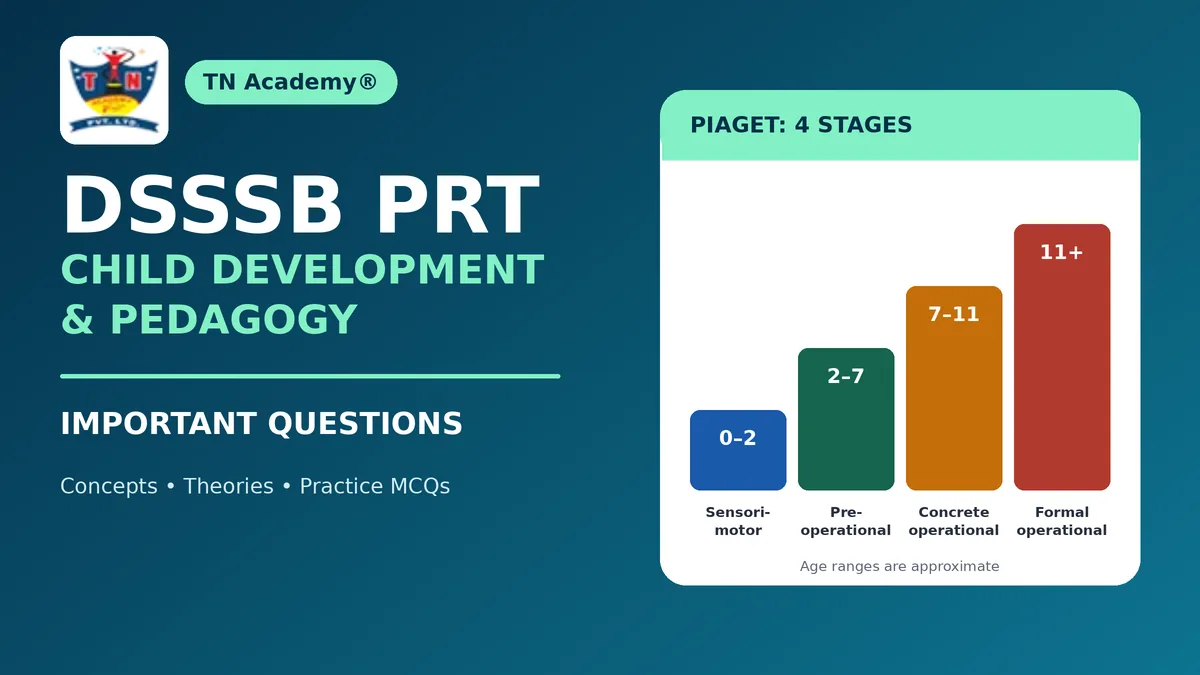
Jean Piaget explained cognitive development through four major stages.
| Stage | Approximate age |
|---|---|
| Sensorimotor stage | Birth to approximately 2 years |
| Preoperational stage | Approximately 2–7 years |
| Concrete operational stage | Approximately 7–11 years |
| Formal operational stage | Approximately 11 years onward |
These age ranges are approximate. Individual children may show differences in their development.
Teachers can use Piaget’s theory to understand how children’s thinking changes and why concrete examples and hands-on activities are useful in primary classrooms.
4. Vygotsky’s Sociocultural Theory
Lev Vygotsky emphasised the role of social interaction and cultural context in learning.
The Zone of Proximal Development (ZPD) describes the gap between what a learner can do independently and what the learner can achieve with suitable assistance.
Teachers can use guided practice, questioning, peer learning and scaffolding to support progress.
5. Learning Theories
Behaviourism
Behaviourist approaches examine observable behaviour and the role of environmental consequences in learning.
Constructivism
Constructivist approaches emphasise that learners actively construct understanding through experience, exploration and reflection.
Learning through Observation
Albert Bandura’s social learning theory highlights learning through observing and modelling the behaviour of others.
Teachers can use demonstrations, examples, guided activities and constructive feedback to support learning.
6. Inclusive Education
Inclusive education aims to ensure that learners can participate meaningfully in educational settings, including children with disabilities and diverse learning needs.
Useful classroom practices include:
- Providing accessible learning materials.
- Using varied teaching methods.
- Offering clear instructions and additional support when needed.
- Encouraging participation without discrimination.
- Assessing learning through suitable methods.
- Respecting individual differences.
Teachers should follow applicable educational policies, disability-related provisions and school procedures.
7. Assessment and Evaluation
Assessment helps teachers understand learners’ progress and identify learning gaps.
Formative assessment:
Takes place during learning and provides feedback for improvement.
Summative assessment:
Evaluates learning at the end of a unit, term or course.
Diagnostic assessment:
Helps identify specific difficulties or misconceptions.
Effective assessment should support learning rather than merely label students.
DSSSB PRT Pedagogy Practice Questions
Question 1 — Cognitive Development
Which psychologist is associated with the stages of cognitive development?
- A. Jean Piaget
- B. Ivan Pavlov
- C. B. F. Skinner
- D. Edward Thorndike
Correct answer: A. Jean Piaget
Explanation: Piaget explained cognitive development through four stages.
Question 2 — Zone of Proximal Development
What does the Zone of Proximal Development describe?
- A. Only what a child can do independently
- B. Learning that can be achieved with appropriate support
- C. Physical growth alone
- D. A method of final examination
Correct answer: B. Learning that can be achieved with appropriate support
Explanation: ZPD is the gap between independent performance and what a learner can achieve with suitable assistance.
Question 3 — Diagnostic Assessment
Which assessment is primarily used to identify specific learning difficulties?
- A. Diagnostic assessment
- B. Summative assessment
- C. Final ranking
- D. Attendance assessment
Correct answer: A. Diagnostic assessment
Explanation: Diagnostic assessment helps identify specific difficulties or misconceptions.
Question 4 — Inclusive Education
What is the main objective of inclusive education?
- A. Teaching only high-performing learners
- B. Separating all learners by ability
- C. Supporting meaningful participation for diverse learners
- D. Using only lecture-based teaching
Correct answer: C. Supporting meaningful participation for diverse learners
Explanation: Inclusive education aims at meaningful participation of all learners.
Question 5 — Constructivism
Which approach encourages students to build understanding through active participation?
- A. Constructivist approach
- B. Rote memorisation only
- C. Punishment-based instruction
- D. Passive copying
Correct answer: A. Constructivist approach
Explanation: Constructivist approaches emphasise that learners actively construct understanding.
How to Prepare Child Development and Pedagogy
- Read each theory with its central concept and classroom application.
- Make comparison tables for important psychologists and learning theories.
- Practise scenario-based questions.
- Study inclusive education and assessment methods.
- Revise concepts through short notes and practice quizzes.
- Check the relevant DSSSB PRT syllabus before finalising the study plan.
Frequently Asked Questions
Q1. What is Child Development and Pedagogy?
It is the study of children’s development and the principles and practices that support effective teaching and learning.
Q2. Why is educational psychology important for primary teachers?
It helps teachers understand learners’ needs, motivation, development and classroom behaviour.
Q3. How should I prepare for DSSSB PRT pedagogy questions?
Study key theories, connect them with classroom situations and practise questions based on the official syllabus.
Q4. Where can I find official DSSSB recruitment information?
Visit the Delhi Subordinate Services Selection Board website: https://dsssb.delhi.gov.in/
DSSSB PRT Preparation at TN Academy®
TN Academy® is a government job coaching institute in Bahadurgarh, Delhi NCR. Aspiring teachers can contact the academy to enquire about relevant teaching recruitment preparation, pedagogy practice and available batches.
Call/WhatsApp: 9729299034
Website:https://tnacademy.in/
Campus: 3rd Floor, Radha Ganga Arcade, Opp. Jhajjar Mod, Delhi–Rohtak Road, Metro Pillar 848, Bahadurgarh, Haryana 124507.
Ask about the current DSSSB PRT preparation schedule, course details, fees and demo availability.
Disclaimer: The relevant DSSSB notification is the authoritative source for the examination pattern, eligibility and syllabus.
DSSSB PRT Course Enquiry
DSSSB PRT preparation aur pedagogy practice ke courses ki jaankari ke liye sampark karein.
📞 Call / WhatsApp: 9729299034
Website: https://tnacademy.in/
TN Academy® coaching aur guidance provide karta hai. Selection official recruitment process aur candidate performance par depend karta hai.

You may also like
DSSSB Special Educator Written Exam Preparation: Complete Strategy
DSSSB PGT Written Exam: Subject-Wise Preparation Guide

