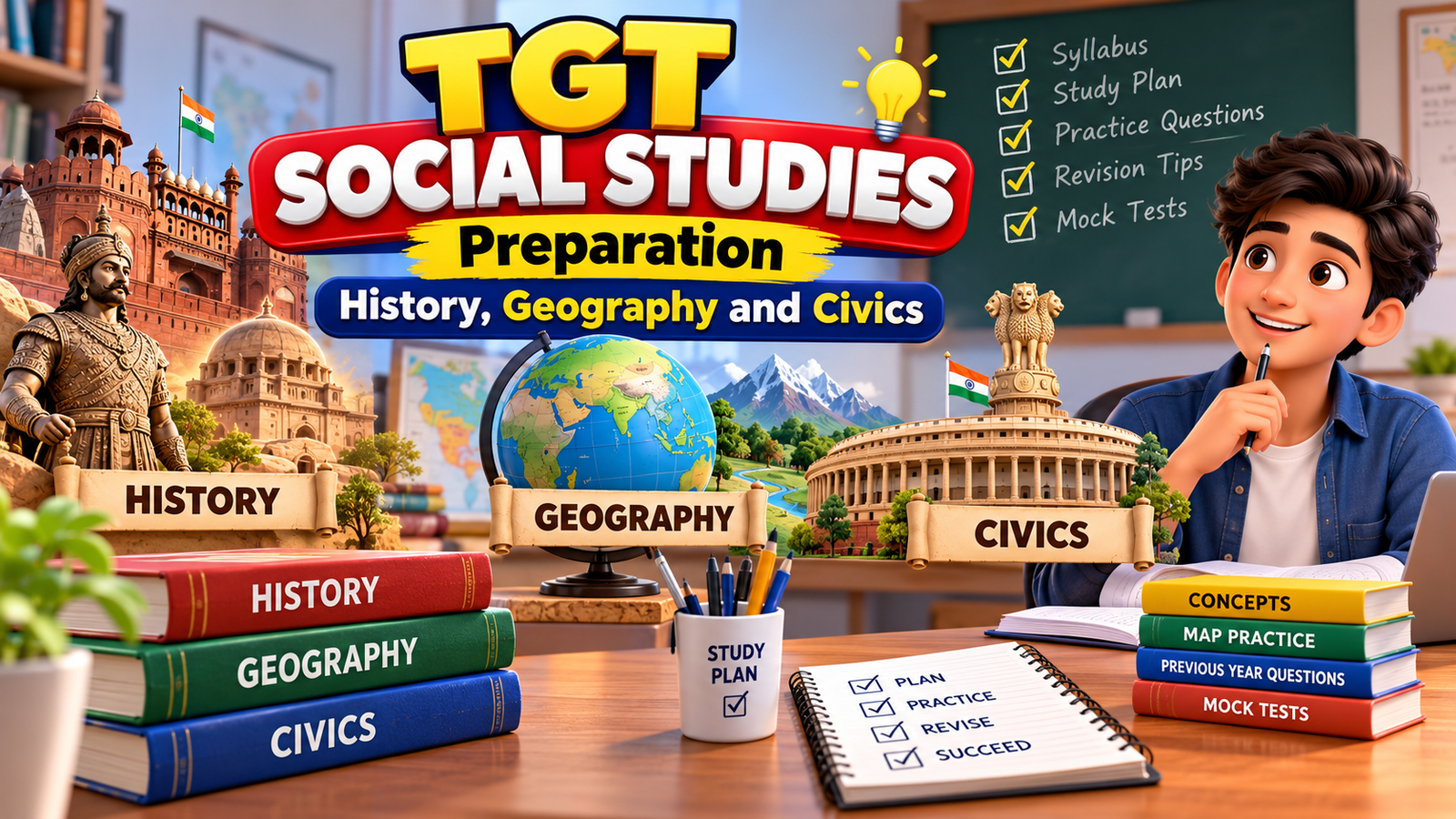
TGT Social Studies Preparation: History, Geography and Civics
Preparing for a TGT Social Studies examination requires a clear understanding of History, Geography, Civics and other subjects included in the relevant recruitment syllabus. A well-planned study strategy can help candidates strengthen their concepts, improve accuracy and prepare more effectively for the examination.
Whether you are starting your preparation from scratch or revising the syllabus, focusing on important topics, practising previous-year questions and taking regular mock tests can make your preparation more organised.
In this guide, you will learn how to prepare for TGT Social Studies, which topics to cover in History, Geography and Civics, how to follow a four-week study plan, and how to improve your performance through regular revision.
Important: The exact syllabus, examination pattern, subject weightage and eligibility criteria may differ between recruiting authorities. Always check the latest official notification for your target TGT examination before starting your preparation.
1. Understand the TGT Social Science Syllabus
Before beginning your preparation, download the official syllabus for your target recruitment examination. Identify the subjects, important topics and examination requirements mentioned in the notification.
Depending on the recruiting authority, the syllabus may include:
- History: Ancient, Medieval and Modern Indian History.
- Geography: Physical Geography, Indian Geography and Human Geography.
- Civics or Political Science: Indian Constitution, democracy and political institutions.
- Economics: Basic economic concepts and development, where applicable.
- Other prescribed topics: Any additional subject areas mentioned in the official syllabus.
Create a checklist of all topics and divide them into three categories: completed, in progress and yet to be studied. This will help you track your progress and allocate study time effectively.
2. TGT History Preparation: Important Topics and Study Strategy
History preparation requires an understanding of historical events, their chronology, important personalities and the causes and consequences of major developments.
Instead of memorising isolated facts, focus on understanding how historical events are connected.
Important Topics in History
- Ancient Indian History
- Medieval Indian History
- Modern Indian History
- The Indian National Movement
- Important historical personalities and their contributions
- Major social, political and economic developments
- Important movements, reforms and historical events
- World History, wherever included in the syllabus
How to Prepare History for TGT
1. Prepare historical timelines: Arrange important events in chronological order to remember dates, movements and developments more effectively.
2. Make short revision notes: Record important rulers, personalities, reforms, battles and movements in concise notes.
3. Use comparison tables: Compare historical periods, administrative systems, important leaders and social reforms to identify their similarities and differences.
4. Practise topic-wise MCQs: Solve multiple-choice questions after completing each chapter to test your understanding.
5. Revise regularly: Review previously studied topics instead of waiting until the entire syllabus is complete.
Pro Tip: Maintain a separate notebook for important dates, historical personalities and frequently repeated mistakes. Revise it regularly before mock tests.
3. TGT Geography Preparation: Important Topics and Study Strategy
Geography becomes easier when you combine conceptual learning with maps, diagrams and real-world examples. Understanding geographical processes is generally more useful than memorising disconnected facts.
Important Topics in Geography
- Physical Geography
- Landforms and climatic processes
- Mountains, plateaus and plains
- Indian rivers and drainage systems
- Climate and monsoon
- Agriculture and soil types
- Natural resources and minerals
- Population and Human Geography
- Industries and transportation
- Environmental Geography
- World Geography, according to the prescribed syllabus
How to Prepare Geography for TGT
1. Practise map-based questions: Regularly locate important rivers, mountain ranges, states, agricultural regions and other geographical features.
2. Understand concepts: Learn how climate, soil, natural resources and agriculture are connected.
3. Prepare diagrams: Use labelled diagrams to revise physical features and geographical processes.
4. Create topic-wise notes: Maintain concise notes covering important terms, locations, examples and geographical facts.
5. Solve practice questions: Test your understanding through chapter-wise MCQs and timed practice sessions.
Pro Tip: Spend a few minutes practising maps during every Geography study session. Consistent practice can help improve recall and accuracy.
4. TGT Civics and Political Science Preparation
Civics and Political Science focus on the Constitution, democratic institutions, citizens’ rights, government structures and political processes.
A clear understanding of constitutional provisions and institutional responsibilities is essential for effective preparation.
Important Topics in Civics
- The Constitution of India
- Fundamental Rights
- Fundamental Duties
- Directive Principles of State Policy
- Parliament and the executive
- The President and the Prime Minister
- The judiciary and constitutional bodies
- Federalism and Centre-State relations
- Panchayati Raj and local government
- Elections and democratic participation
- Political institutions and governance
How to Prepare Civics for TGT
1. Study constitutional concepts carefully: Understand the purpose and significance of important constitutional provisions.
2. Differentiate between similar concepts: Prepare comparison tables for Fundamental Rights, Fundamental Duties and Directive Principles of State Policy.
3. Use flowcharts: Visualise the functioning of Parliament, the executive, the judiciary and local government institutions.
4. Revise important provisions: Make concise notes on constitutional parts, institutions and other syllabus-relevant facts.
5. Verify information: Use reliable textbooks and official sources when checking constitutional provisions or recent legal developments.
Pro Tip: Focus on understanding the role and functions of each institution rather than memorising names and definitions alone.
5. Four-Week TGT Social Studies Study Plan
A structured timetable can help you cover the major subjects systematically. The following four-week plan is a starting point that you can adjust according to your available time, preparation level and examination date.
| Week | Main Focus | Preparation Tasks |
|---|---|---|
| Week 1 | History | Study important historical periods, prepare timelines and solve chapter-wise MCQs. |
| Week 2 | Geography | Cover major concepts, practise maps and revise important geographical facts. |
| Week 3 | Civics and Political Science | Study constitutional concepts, political institutions and democratic processes. |
| Week 4 | Revision and Practice | Revise short notes, solve mixed questions and take timed mock tests. |
Daily Study Routine
Follow this sample routine and adjust the duration according to your schedule.
- Conceptual Study: Learn a new topic and understand its main concepts.
- Practice Questions: Solve MCQs related to the topic studied.
- Revision: Review previous notes, important facts and incorrect answers.
- Weekly Assessment: Take a short test to evaluate your preparation.
Try to maintain consistency rather than studying for long hours on only a few days. If your examination is approaching, prioritise syllabus coverage, weak topics and regular revision.
6. TGT Social Studies Practice Questions with Answers
Practising objective questions helps you evaluate your understanding and identify topics that need additional revision.
Question 1: Which part of the Indian Constitution contains the Fundamental Rights?
Answer: Part III.
Question 2: Which movement began with Mahatma Gandhi’s Dandi March in 1930?
Answer: The Civil Disobedience Movement.
Question 3: Which imaginary line divides the Earth into the Northern and Southern Hemispheres?
Answer: The Equator.
Question 4: What is the primary purpose of the Directive Principles of State Policy?
Answer: To guide the State in formulating policies aimed at social and economic welfare.
Question 5: Which branch of government interprets the Constitution and adjudicates disputes within its jurisdiction?
Answer: The judiciary, with the Supreme Court serving as India’s apex court.
Practice Tip: Attempt the questions without looking at the answers first. Review any incorrect response and revise the relevant concept before moving to the next topic.
7. How to Improve Your TGT Social Studies Score
Improving your score requires more than completing the syllabus. You also need to revise effectively, practise questions and analyse your performance.
Follow these preparation tips:
- Download the official syllabus: Make sure your study material matches your target recruitment examination.
- Set daily targets: Divide large topics into smaller, manageable study sessions.
- Understand concepts first: Focus on conceptual clarity before memorising facts.
- Practise previous-year questions: Use authentic question papers whenever available.
- Revise maps regularly: Give special attention to map-based Geography questions.
- Use active recall: Test yourself without looking at your notes.
- Take regular mock tests: Practise answering questions within the prescribed time.
- Analyse mistakes: Identify whether errors occur because of weak concepts, incorrect recall or careless reading.
- Revise weak topics: Spend additional time on areas where your accuracy is low.
- Track your progress: Maintain a record of completed topics, test scores and recurring mistakes.
A consistent preparation routine can help you build confidence and improve your readiness for the examination.
8. Frequently Asked Questions About TGT Social Studies Preparation
Q1. Which subjects are included in TGT Social Studies?
The exact subject combination depends on the recruiting authority. History, Geography, Civics or Political Science, and sometimes Economics may be included according to the applicable syllabus.
Q2. How should I prepare Geography for TGT?
Combine conceptual study with map practice, labelled diagrams, short notes and topic-wise multiple-choice questions. Regular revision can help strengthen your understanding.
Q3. Are mock tests necessary for TGT Social Studies preparation?
Mock tests help you assess your knowledge, time management and accuracy. Analysing incorrect answers after each test is an important part of the learning process.
Q4. Should I follow the same syllabus for every TGT examination?
No. Different recruiting authorities may prescribe different syllabi, subject combinations, eligibility criteria and examination patterns. Always refer to the relevant official notification.
Q5. How can I revise TGT Social Studies effectively?
Prepare short notes, revise important concepts, practise active recall, solve previous-year questions and revisit topics where you make repeated mistakes.
Q6. Is coaching necessary for TGT Social Studies?
Coaching is a personal choice. Some candidates prefer self-study, while others benefit from structured classes, expert guidance, doubt-solving sessions and regular assessments. Choose an approach that suits your learning needs and preparation goals.
9. TGT Social Studies Guidance at TN Academy®
TN Academy® is a government job coaching institute located in Bahadurgarh, Haryana, in the Delhi NCR region. Candidates preparing for teaching recruitment examinations can contact the academy to enquire about relevant batches, subject preparation and counselling options.
Contact Details
Phone/WhatsApp: 9729299034
Website: https://tnacademy.in/
Address: 3rd Floor, Radha Ganga Arcade, Opp. Jhajjar Mod, Delhi–Rohtak Road, Metro Pillar 848, Bahadurgarh, Haryana – 124507.
Candidates are encouraged to enquire about the current TGT Social Studies schedule, faculty availability, course details and demo options before enrolling.
Conclusion
Effective TGT Social Studies Preparation depends on understanding the syllabus, building strong subject concepts, practising questions and revising regularly. History requires chronological understanding, Geography benefits from map practice, and Civics becomes easier when you understand constitutional principles and political institutions.
Start with a realistic study plan, evaluate your progress every week and focus on improving your weak areas. Most importantly, ensure that your preparation follows the latest official syllabus and examination guidelines for your target recruitment.
Disclaimer: This article provides general preparation guidance. Always refer to the relevant recruiting authority’s official notification for the latest syllabus, eligibility criteria, examination pattern and recruitment-related updates.