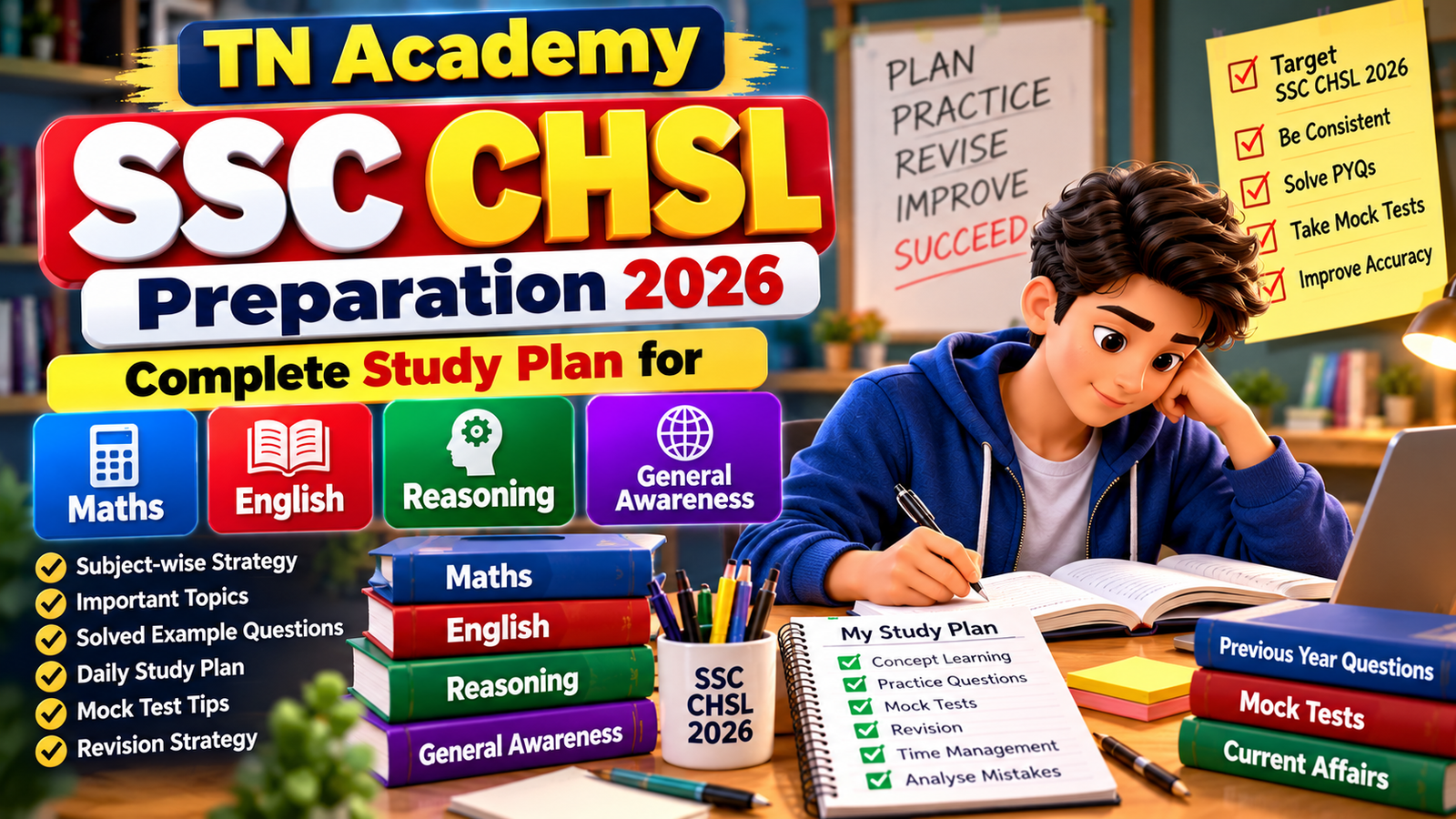
SSC CHSL Preparation 2026: Complete Study Plan for Maths, English, Reasoning and General Awareness
Preparing for the Staff Selection Commission Combined Higher Secondary Level (SSC CHSL) examination requires a clear study plan, regular practice and consistent revision. Candidates preparing for SSC CHSL should focus on Quantitative Aptitude, English Language, General Intelligence and General Awareness according to the applicable official examination scheme.
A structured preparation strategy can help you identify weak areas, improve accuracy and manage your study time more effectively. Instead of collecting too many books or changing your timetable frequently, focus on understanding concepts, solving questions and analysing your mistakes.
In this guide, you will learn how to prepare for SSC CHSL, which topics to practise, how to create a daily timetable and how to use mock tests and previous year questions effectively.
Important: Check the latest official SSC notification and syllabus for the relevant examination year. Always verify the examination pattern, marking scheme, qualifying criteria and applicable skill-test requirements from the official source.
1. Understand the SSC CHSL Exam Pattern and Syllabus
Before beginning your preparation, understand the examination structure and the subjects included in the current syllabus. This will help you organise your study schedule and allocate time according to your preparation level.
Review the following points:
- Latest SSC CHSL syllabus and examination pattern.
- Examination stages and applicable modules.
- Marking scheme and negative marking rules.
- Prescribed qualifying criteria.
- Typing or skill-test requirements, wherever applicable.
- Official examination calendar and notifications.
Once you understand the syllabus, divide the subjects into manageable topics and set weekly study targets.
2. How to Prepare Maths for SSC CHSL
Mathematics preparation requires conceptual clarity, regular calculation practice and formula revision. Start with basic concepts and gradually move towards timed question sets.
Important Maths Topics for SSC CHSL
Practise relevant syllabus topics such as:
- Percentage, ratio and proportion
- Average and number systems
- Profit, loss and discount
- Simple and compound interest
- Time and work
- Speed, time and distance
- Algebra and geometry
- Mensuration and trigonometry
- Data interpretation
Confirm the exact topics against the latest official syllabus.
SSC CHSL Maths Preparation Strategy
- Understand the concept before memorising formulas.
- Solve basic questions before attempting difficult ones.
- Maintain a separate notebook for formulas and shortcuts.
- Practise timed question sets to improve calculation speed.
- Record calculation errors and revise them regularly.
Solved Maths Example: Percentage
Question: A candidate scores 72 marks out of 90. What is the percentage?
Formula:
Percentage = (Marks obtained ÷ Total marks) × 100
Solution:
= (72 ÷ 90) × 100
= 80%
Answer: 80%
Practise similar questions using different values. Focus on accuracy first, then work on solving questions more efficiently.
3. How to Prepare English for SSC CHSL
English preparation involves grammar, vocabulary, sentence structure and reading comprehension. Daily practice is more useful than studying these topics only occasionally.
Important English Topics
Focus on relevant syllabus areas, including:
- Grammar and sentence structure
- Error spotting
- Fill in the blanks
- Synonyms and antonyms
- One-word substitutions
- Idioms and phrases
- Sentence improvement
- Cloze tests
- Reading comprehension
- Vocabulary and correct word usage
SSC CHSL English Preparation Strategy
- Revise one grammar rule every day.
- Learn new vocabulary and revise previously learned words.
- Practise error-spotting and sentence-improvement questions.
- Read short passages and identify their main ideas.
- Maintain a notebook of recurring grammar and vocabulary mistakes.
Solved English Example
Question: Choose the grammatically correct sentence.
A. She go to school every day.
B. She goes to school every day.
C. She going to school every day.
D. She gone to school every day.
Correct Answer: B. She goes to school every day.
Explanation: In the simple present tense, a singular third-person subject such as “she” takes the verb form “goes”.
4. How to Prepare Reasoning for SSC CHSL
Reasoning preparation becomes more systematic when you understand common question patterns and practise them topic by topic. Focus on identifying the logic behind each question instead of memorising answers.
Important Reasoning Topics
- Analogy and classification
- Number and alphabet series
- Coding-decoding
- Blood relations
- Direction sense
- Order and ranking
- Venn diagrams
- Logical relationships
- Non-verbal reasoning
- Other topics included in the current syllabus
SSC CHSL Reasoning Preparation Strategy
- Learn the basic logic of each question type.
- Solve topic-wise questions regularly.
- Attempt questions independently before checking solutions.
- Review incorrect answers and understand the underlying pattern.
- Practise mixed-topic tests under timed conditions.
Solved Reasoning Example: Number Series
Question: Find the next number: 3, 6, 12, 24, __?
Solution: Each number is multiplied by 2.
3 × 2 = 6
6 × 2 = 12
12 × 2 = 24
24 × 2 = 48
Answer: 48
When solving number-series questions, check whether the sequence follows a consistent pattern before selecting an answer.
5. How to Prepare General Awareness for SSC CHSL
General Awareness preparation requires regular revision, reliable study materials and frequent self-testing. Divide the subject into smaller areas so that you can revise facts without becoming overwhelmed.
Important General Awareness Topics
- Indian history
- Indian geography
- Indian polity
- Basic economics
- General science
- Environment
- Art and culture
- Important national and international events
- Current affairs relevant to the examination period
SSC CHSL General Awareness Preparation Strategy
- Study one small topic every day.
- Prepare concise notes for quick revision.
- Practise topic-wise multiple-choice questions.
- Revise previously studied facts at regular intervals.
- Maintain a separate notebook for current affairs.
- Verify important facts using reliable sources.
Avoid relying entirely on unverified social media posts or lengthy compilations that leave little time for revision.
Solved General Awareness Example
Question: Which part of the Indian Constitution contains the Fundamental Rights?
A. Part I
B. Part II
C. Part III
D. Part IV
Correct Answer: C. Part III
Explanation: Fundamental Rights are provided under Part III of the Constitution of India.
6. Daily Study Timetable for SSC CHSL Preparation
A practical SSC CHSL study plan should include concept learning, question practice and revision. Adjust the timetable according to your available time, current preparation level and weaker subjects.
| Study Session | Time | Activity |
|---|---|---|
| Session 1 | 60 minutes | Maths concepts and practice |
| Session 2 | 60 minutes | English grammar and vocabulary |
| Session 3 | 60 minutes | Reasoning questions |
| Session 4 | 30 minutes | General Awareness |
| Session 5 | 30 minutes | Revision and error analysis |
| Total | 4 hours | Daily preparation |
This is a sample timetable, not a compulsory rule. If you have additional time, include mock tests and extra practice in your weaker subjects.
The most important part of a study timetable is consistency. Set realistic targets and review your progress every week.
7. How to Use SSC CHSL Mock Tests and Previous Year Questions
Mock tests and previous year questions help you understand question formats, practise time management and identify areas that need improvement.
Follow this process after every mock test:
- Attempt the test under realistic time conditions.
- Review incorrect and unanswered questions.
- Categorise mistakes as conceptual, calculation-based, memory-based or time-management errors.
- Revise the relevant concepts.
- Practise similar questions again.
- Compare your performance across multiple tests.
Do not judge your preparation based on a single mock-test score. Look for recurring mistakes and track whether your accuracy and time management improve over time.
Previous year questions should be used alongside the latest official syllabus and examination information.
8. Common SSC CHSL Preparation Mistakes to Avoid
Avoid these common mistakes while preparing for SSC CHSL:
- Studying without checking the official syllabus.
- Ignoring weak subjects.
- Collecting too many books and study resources.
- Memorising formulas without practising their application.
- Skipping regular revision.
- Attempting mock tests without analysing mistakes.
- Depending on unverified examination updates.
- Ignoring typing or skill-test preparation when applicable.
A consistent routine, focused practice and regular error analysis can make your preparation more organised.
9. SSC CHSL Coaching in Bahadurgarh: How to Explore Your Options
Candidates who prefer additional academic guidance can compare available SSC CHSL preparation options before choosing a course. Consider the teaching approach, subject coverage, practice opportunities, batch timings, fees and counselling support.
TN Academy® provides competitive-examination preparation support through structured learning and practice-oriented guidance.
Students interested in SSC CHSL preparation can enquire about currently available courses, teaching arrangements and practice sessions. Candidates considering classroom preparation in Bahadurgarh or the wider Delhi NCR region should confirm the available batch, subjects, fees and schedule before visiting.
Need guidance for your SSC CHSL preparation?
- Call or WhatsApp: 9729299034
- Website: https://tnacademy.in/
Contact TN Academy® to discuss your preparation requirements and enquire about available course options.
10. SSC CHSL Preparation Checklist
Before your next practice test, check whether you have completed the following tasks:
- Reviewed the relevant official syllabus.
- Practised Maths questions.
- Revised English grammar and vocabulary.
- Completed a Reasoning practice set.
- Revised General Awareness.
- Analysed mistakes from previous tests.
- Updated your revision notebook.
- Checked official SSC notifications for relevant changes.
Use this checklist to identify incomplete tasks and plan your next study session.
A clear study plan, regular practice and focused revision can help you prepare more systematically for the SSC CHSL examination.
Frequently Asked Questions (FAQs)
1. How should I start SSC CHSL preparation?
Start by reviewing the latest official syllabus and examination pattern. Assess your current level in Maths, English, Reasoning and General Awareness, then create a realistic daily timetable.
2. Can I prepare for SSC CHSL at home?
Yes. Self-study can include reliable books, practice questions, previous year papers, mock tests and regular revision. Candidates who need additional guidance may also explore suitable coaching options.
3. How many hours should I study daily for SSC CHSL?
Study time depends on your current level, available time and preparation target. A four-hour daily routine can be a starting point if it includes concept learning, question practice and revision.
4. Which subject should I study first for SSC CHSL?
Begin with the subject that needs the most improvement while maintaining regular practice in all relevant sections. Adjust your timetable based on your performance.
5. Are previous year questions useful for SSC CHSL preparation?
Yes. Previous year questions help you practise relevant concepts and understand question formats. Use them alongside the latest official syllabus.
6. How can I improve my SSC CHSL mock-test score?
Review incorrect answers, identify recurring weaknesses, revise the relevant concepts and practise similar questions before attempting another test.
7. Where can I enquire about SSC CHSL coaching in Bahadurgarh?
You can contact TN Academy® at 9729299034 to enquire about available preparation courses, batches and counselling.
Final Thoughts
Effective SSC CHSL preparation depends on understanding the syllabus, practising questions consistently and revising mistakes. Divide your preparation into manageable daily tasks, assess your progress through mock tests and use the latest official examination information to guide your study plan.
Plan your preparation, practise regularly and keep improving one topic at a time.

You may also like
DSSSB PRT Written Exam Preparation: Syllabus-Based Study Strategy